Collecting Signed Navajo Jewelry: How to Buy, Verify and Keep It
Quick answer: To collect signed Navajo jewelry, buy from sellers who name the artist, then check that the hallmark matches the maker’s documented work and era. A signature is a lead, not proof: marks get shared and forged. Get the maker’s name and tribal affiliation on your receipt, keep every record, and don’t over-polish old silver.
A name on the back makes a ring or cuff feel traceable, and for contemporary work it usually is. But good collectors treat a signature as the first question, not the answer. This guide covers what a mark proves, what to expect by era, how to check a signed piece before you pay, and how to keep a collection’s value intact. For the wider history, start with our Navajo jewelry guide.

Why do collectors look for signed Navajo jewelry?
Because a verified signature connects a piece to a person. Once you know the maker, you can learn their techniques and period. Collectors of one artist also compete for a limited body of work, which is why a known name can carry a premium.
Signing is also how many artists claim their work today. The FTC and Indian Arts and Crafts Board brochure tells buyers to look for the artist’s hallmark and notes that “many Indian artists use a hallmark — a symbol or signature — to identify their work.”
The catch is that premiums attract fakes. As T.Skies Co-Op notes, forged hallmarks target exactly the names that command premiums. The real skill isn’t finding a mark. It’s checking whether everything else about the piece agrees with it.
What does a signature on Navajo jewelry actually prove?
On its own, a probable maker and nothing more. A hallmark is usually stamped with a punch, though some artists engrave their name. The marks you’ll find on the back of a piece mean different things:
| What you see | What it tells you | What it doesn’t prove |
|---|---|---|
| Artist name, initials or symbol (stamped or engraved) | A probable maker you can research | Who made it on its own: marks are shared, reused by relatives and forged |
| STERLING or .925 | The maker is claiming at least 92.5% silver, the FTC standard for “sterling” | Anything about the maker or Native origin |
| COIN | A claim of at least 90% silver under the FTC Guides; common on early work | Age or maker by itself |
| U.S. NAVAJO plus a number | Submitted through the federal stamping program, 1938–1943, via a numbered trader, school or guild | The individual smith |
| Horned-moon Guild mark | Handled by the Navajo Arts and Crafts Guild (trademark registered 1943) | The individual smith; the mark has also been seen on pieces not stamped at the Guild |
| Trader or shop stamp, paper tag | Where a piece was sold | That it’s Native-made; a name on a tag isn’t a signature |
Our own inventory shows why initials are only a lead. We carry rings by two different Navajo silversmiths, Randy Billy and Randy Boyd, and both listings record the same hallmark: “RB” with Sterling. Without the seller’s records, the letters alone couldn’t tell you which artist made which ring. For a full walk-through of mark types and where to find them, see our guide to Navajo hallmarks.
When did Navajo silversmiths start signing their work?
Later than most new collectors expect. Hallmark researcher Bille Hougart, quoted by T.Skies Co-Op, writes that “only since the 1920s did a few individuals begin to identify themselves” on their silver, and that most makers stayed anonymous to buyers until after World War II. Hougart also notes that skilled women smiths often used the stamps of husbands or relatives.
| Period | What to expect | Collector’s takeaway |
|---|---|---|
| Before the 1920s | Unsigned by default | No mark is normal; a famous signature here is a warning sign |
| 1920s to World War II | A few individuals began to mark their silver | Most pieces still unsigned; judge by construction and history |
| 1938–1943 | Federal “U.S. NAVAJO” quality stamps with trader numbers | Collectible program marks that don’t name the smith |
| 1941 onward | Navajo Arts and Crafts Guild organized; from 1955 it urged members to use their own hallmarks | Guild-era pieces may carry both a Guild mark and a personal mark |
| Contemporary work | Most artists sign, often with STERLING or .925 | An unsigned modern piece is worth a question |
The federal program is well documented. According to research by Kim and Pat Messier and Bille Hougart, the Indian Arts and Crafts Board announced its silver standards in March 1937 and stamped the first pieces in Santa Fe on April 5, 1938. Each “U.S. NAVAJO” die carried a number for the trader, school or guild that submitted the work; the last recorded use was June 1943. The T.Skies history of the Navajo Arts and Crafts Guild, citing Hougart, dates the Guild to 1941, its horned-moon trademark to 1943 and its push for personal hallmarks to 1955.
Museums treat unsigned early work with respect, not suspicion. The Heard Museum credits 19th-century Diné pieces, such as a concho belt from about 1880, to “Artist once known,” alongside signed work by contemporary Diné jewelers such as Norbert Peshlakai, Jesse Monongye and Perry Shorty.
How do you check a signed Navajo piece before you buy?
Work through these six steps, in order, for any piece sold as signed or Navajo-made:
- Find every mark. Check the inside of rings and cuffs, the back of pendants and conchos, and the area behind each stone. Use good light and a 10x loupe.
- Separate the maker’s mark from the metal mark. STERLING or .925 describes the silver. A name, initials or a small symbol is the candidate artist hallmark. Guild, trader and U.S. NAVAJO stamps name a program or business, not a smith.
- Photograph and transcribe it exactly. Copy the mark with its spacing, periods and symbols, and photograph it under angled light before any cleaning.
- Look it up and treat initials as a lead. Compare the mark with a hallmark reference such as Bille Hougart’s Native American and Southwestern Silver Hallmarks. Short initials are shared by several makers, so a match is a lead, not a verdict.
- Check that the piece fits the maker and era. The construction, stones and style should agree with what the named artist made and when. A famous mark on a piece that looks wrong for that maker is a red flag.
- Get the claim in writing. Ask for a receipt naming the maker, the maker’s tribal affiliation and the price, plus a written guarantee of authenticity, as the Indian Arts and Crafts Board recommends.

A signature also doesn’t tell you whether the turquoise is natural, stabilized or an imitation. The FTC and IACB brochure notes that the majority of turquoise used today is stabilized. For the checks, see how to tell if turquoise is real and stabilized vs natural turquoise.
Is signed Navajo jewelry worth more than unsigned?
Sometimes, and only after the signature is verified. A documented mark from a collected artist, on a piece that fits their work, can add real value. An untraceable mark adds little, and a famous mark on a piece that doesn’t match the maker raises the question of forgery.
Several other factors weigh as much as the name:
- Handmade vs handcrafted. Ira Wilson of the Southwestern Association for Indian Arts told New Mexico Magazine that handmade means building a piece from the ground up, including the stone work, while handcrafted means assembling purchased parts. Both are legitimate, but the difference affects price.
- Silver. Under the FTC Jewelry Guides, “sterling” must be at least 92.5% silver and “coin silver” at least 90%. Weight matters on heavy pieces, so ask for it if the listing doesn’t say.
- Stones. Natural, high-grade turquoise from a documented mine usually costs more than stabilized stone.
- Condition and completeness. Original stones, intact bezels and complete sets hold value better than repaired or broken-up pieces.
- Records. A receipt, artist card or old trading post tag adds credibility a stamp can’t.
What paperwork should you keep with a signed piece?
Keep everything. The Indian Arts and Crafts Board’s consumer tips recommend a reputable dealer, written verification of authenticity, and a receipt listing the price, the maker and the maker’s tribal affiliation. For antiques, New Mexico Magazine adds provenance.
For each piece, start a simple file with:
- The receipt and any certificate, artist card or tag
- A screenshot of the original listing
- Photos of the front, back and hallmark, taken before cleaning
- Size, measurements, weight and any stone details the seller gave
That file helps with insurance, resale and appraisal. It also protects you legally. The Indian Arts and Crafts Act of 1990 makes it illegal to sell any product in a way that falsely suggests it’s Indian-made or the work of a particular tribe. Its own example is jewelry sold as “Navajo Jewelry” that wasn’t made by a member, or certified Indian artisan, of the Navajo tribe. A first violation can bring an individual up to $250,000 in fines, five years in prison, or both, and a business up to $1,000,000. Enforcement is real: in 2020, three people were sentenced in Arizona for selling jewelry made in the Philippines as Native American made.
Watch the wording too. The FTC and IACB brochure says terms like “Native American heritage” don’t mean the maker is a tribal member, and “Navajo-style” describes a look, not a maker.
Buyer’s tip from Leather Stone Jewels
Start with one maker or one form, such as rings, and buy the best piece you can afford rather than several average ones. Before you pay, ask the seller three questions in writing: who made it, how do you know, and is the stone natural or stabilized? Our listings name the artist and hallmark when we know them, and say whether a piece is Native-made or Native-inspired, sterling or silver-plated. If a detail you need isn’t listed, ask us.
How should you care for a signed Navajo collection?
Gently. The dark patina in stamped designs is part of a piece’s look and history, so avoid silver dips and heavy buffing. Wipe raised silver with a soft cloth, keep turquoise away from chemicals and ultrasonic cleaners, and store pieces separately. Never file or polish over a hallmark to read it. Our guide to how to clean turquoise jewelry covers the safe methods step by step.

Where can you buy signed Navajo jewelry?
The most direct route is the artist. New Mexico Magazine suggests markets such as the Heard Museum Indian Market & Fair in Phoenix, SWAIA’s Santa Fe Indian Market and the Gallup Inter-Tribal Indian Ceremonial. To train your eye first, visit museum collections such as the Heard or the Wheelwright Museum’s Center for the Study of Southwestern Jewelry in Santa Fe, which shows more than 700 works.
These signed pieces are available now at Leather Stone Jewels, a western turquoise, leather and silver jewelry shop in Fort Worth, Texas. Details come from each listing:
- Annie Chapo Signed Vintage Navajo Sterling Turquoise Ring, Size 7 ($149): A vintage ring by Navajo silversmith Annie Chapo, signed “Chapo” on the band, with a turquoise cabochon showing pyrite matrix.
- Randy Billy Navajo Sterling Silver Ring, Size 9 ($235): Hallmark RB with Sterling, 5/8″ × 5/8″, with a stone the listing identifies as Golden Hills turquoise.
- Randy Boyd Navajo Sterling Silver Ring with Fox Turquoise, Size 8.5 ($266): Also hallmarked RB with Sterling, 1 1/4″ × 3/4″. Same initials, different artist.
- Victor Coriz Navajo Concho Link Bracelet with Sleeping Beauty Turquoise ($649): Each concho is stamped Sterling with the artist’s hallmark; adjusts to fit 6″ to 7 1/2″ wrists.
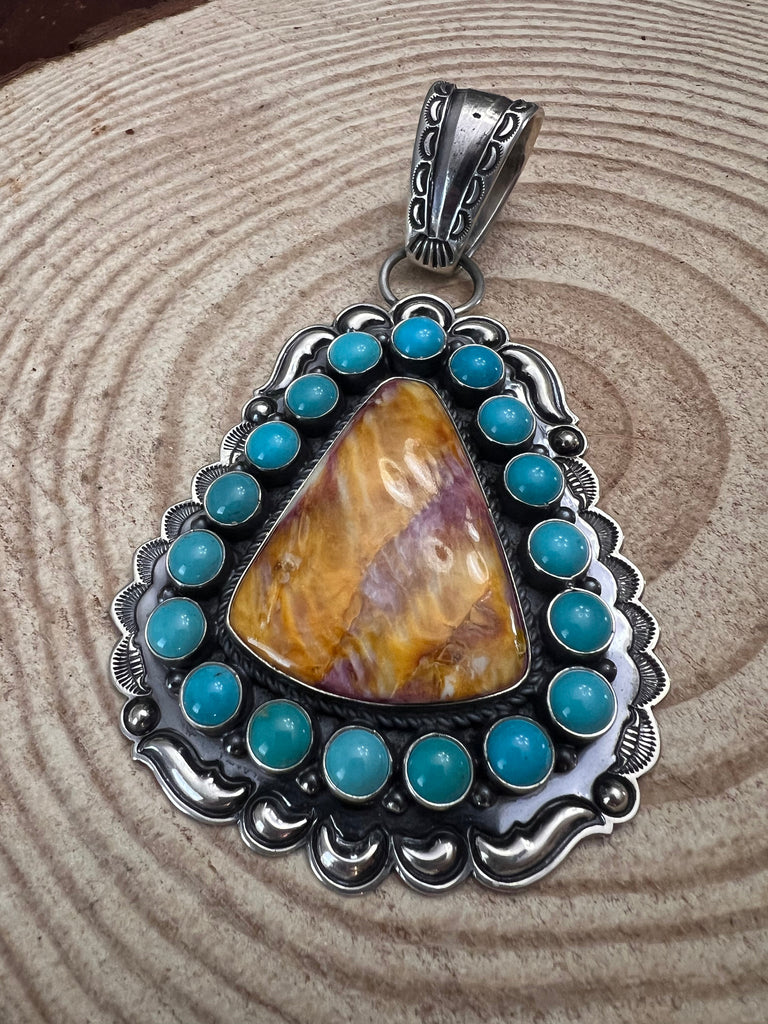
- Roland Dixson Navajo Sterling Silver Statement Pendant ($1,150): Spiny oyster and turquoise, 5″ × 3″, with Roland Dixson’s signature and a Sterling mark stamped on the back. The bail takes beads up to 15 mm.
Our listings don’t state gram weights or whether each stone is natural or stabilized; ask us. See more in our Authentic Native Jewelry collection and our sterling silver rings. If you’re collecting across Southwestern traditions, our guide to Navajo vs Zuni vs Hopi jewelry explains how to tell them apart, and squash blossom necklace meaning covers the best-known Navajo form.
Key facts: collecting signed Navajo jewelry
- A hallmark points to a probable maker. It doesn’t prove authenticity by itself.
- STERLING or .925 describes the metal: at least 92.5% silver under the FTC Jewelry Guides.
- Individual signing began in the 1920s; most Navajo makers stayed anonymous until after World War II.
- “U.S. NAVAJO” stamps come from a 1938–1943 federal program and identify a trader, school or guild, not a smith.
- Get the maker’s name and tribal affiliation on your receipt, as the Indian Arts and Crafts Board advises.
- Under the Indian Arts and Crafts Act, only work by a Navajo Nation member or certified Navajo artisan can be sold as “Navajo.”
Frequently asked questions
Is signed Navajo jewelry worth more than unsigned?
Often, but only when the signature checks out. A verified mark ties a piece to a known artist, and collectors pay for that. Unsigned older work isn’t worth less by default, because most Navajo smiths didn’t sign before World War II. Value also depends on silverwork, stones, condition and records.
Is unsigned Navajo jewelry fake?
No. Individual signing only began in the 1920s, and most makers stayed anonymous until after World War II. The Heard Museum credits many 19th-century Diné pieces to “Artist once known.” An unsigned piece needs other evidence, such as provenance and construction that fits its age.
How do I find out who made my Navajo jewelry?
Photograph the mark, write it down exactly, and compare it with a hallmark reference or a reputable dealer’s records. If a seller sold it to you as Navajo-made, ask them to put the maker’s name and tribal affiliation in writing. For a valuable piece, ask an experienced appraiser.
What does “U.S. NAVAJO” stamped on silver mean?
It’s a government quality stamp from the Indian Arts and Crafts Board program of 1938 to 1943. The number after it identified the trader, school or guild that submitted the work, not the individual silversmith. Pieces with it are collected as part of that history.
Should I polish old Navajo silver?
Go gently. Collectors value the dark oxidation in stamped recesses. Wipe raised areas with a soft silver cloth, and avoid dips, ultrasonic cleaners and chemicals near turquoise.
Signed Navajo pieces, with the maker named
Shop hallmarked and signed Navajo jewelry from Leather Stone Jewels in Fort Worth, TX. Orders ship in 24–48 hours, US shipping is free on orders over $50, and returns are accepted within 7 days in original condition. Use code WELCOME10 for 10% off your first order.
Browse signed artist pieces in our shop, and read our Authenticity Guarantee for how we credit makers and materials.