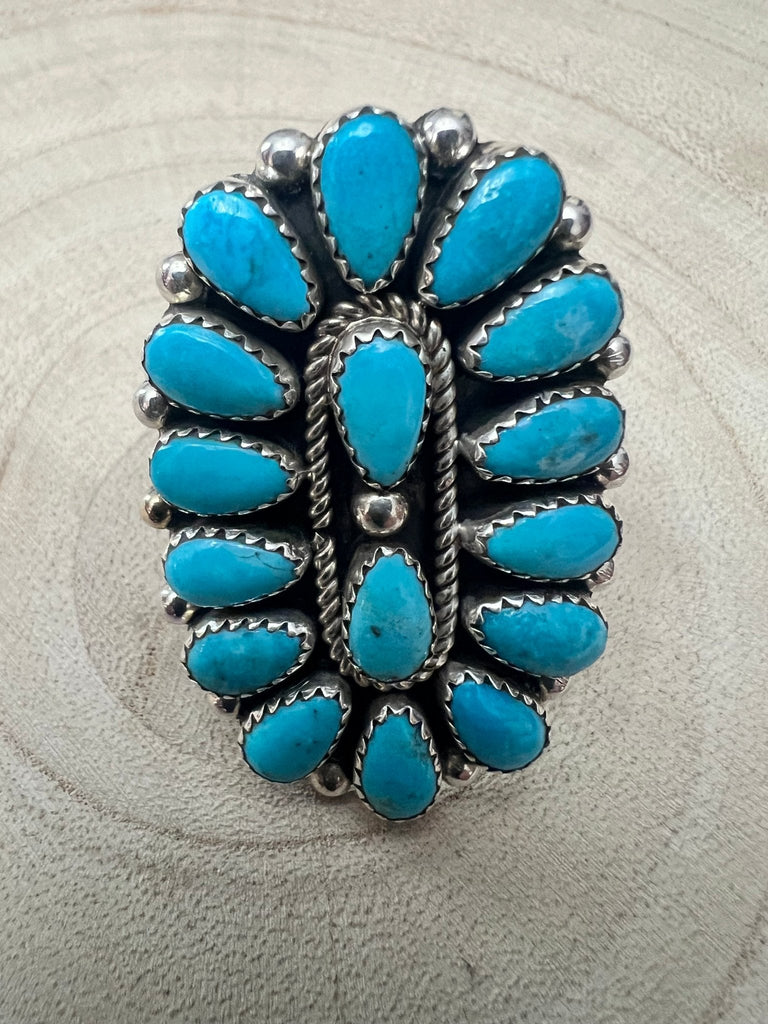
Stabilized vs Natural Turquoise: What’s the Difference?
Quick answer: Natural turquoise is cut and polished with nothing added. Stabilized turquoise is real turquoise that has been filled with clear resin under pressure to harden it and lock in color. Most turquoise sold today is stabilized. Natural stone is rarer and usually costs more, so either is fine if it’s disclosed and priced honestly.
“Is it real?” is the question most turquoise buyers ask. The better question, according to the U.S. Indian Arts and Crafts Board (IACB), is whether the stone is natural. Most blue stone you’ll see falls between untouched natural turquoise and outright imitation, and stabilized turquoise sits in the middle. Building on our Turquoise Buyer’s Guide, this guide explains what each label means, how labs tell them apart, how value and care differ, and what a seller should put in writing.
Stabilized vs natural turquoise, defined
Natural turquoise is, in the IACB’s words, “the stone that comes directly from the earth without any treatments or enhancements.” It is only cut and polished.
Stabilized turquoise is turquoise “combined with colorless resins (plastics) under a vacuum or pressure to harden the stone and darken the color” (IACB). It is genuine turquoise that has been treated.
Why is most turquoise stabilized?
Turquoise forms near the earth’s surface as a mass of tiny crystals rather than one large crystal. The International Gem Society explains that this loose structure leaves most turquoise porous, crumbly and easy to scratch. Porous stone also soaks up skin oils, lotions and dirt, which can shift its color.
The numbers show how rare hard, gem-quality stone is. The IACB estimates that only about 15% of the world’s turquoise supply is natural, and that about 85% comes out of the ground too soft to cut or polish without treatment. A 2021 GIA Gems & Gemology study put the share of mined rough suitable for fashioning into gems at “much less than 5%.” A joint FTC and IACB brochure states plainly that “the majority of turquoise used today is stabilized.”
Stabilization fills those pores with resin, so stone that would otherwise crumble can be cut, set and worn.
How do natural, stabilized, enhanced, reconstituted and imitation turquoise compare?
Stabilized is only one of several categories. The IACB lists oiled or waxed, enhanced, stabilized, blocked and dyed as forms of treated turquoise, and imitations aren’t turquoise at all. Here’s how they compare:
| Type | What it is | Is it turquoise? | Durability and care | Relative value | How it’s identified |
|---|---|---|---|---|---|
| Natural (untreated) | Cut and polished only. Nothing added. | Yes | Hard, dense grades wear well. Porous stone can darken or green as it absorbs skin oils and cosmetics. | Highest, grade for grade | Documentation from the seller. A lab can check for resin or other treatment. |
| Stabilized | Turquoise combined with clear resin under vacuum or pressure to harden it and deepen color | Yes, treated | Harder and less porous, so color is more stable | Moderate. Most of the market. | Lab tests such as infrared spectroscopy. Often very even color and a glassy luster. |
| Enhanced / Zachery | A patented process that darkens color and improves polish without a polymer | Yes, treated | Less porous, more resistant to skin oils | Varies. Must be disclosed. | Hard to spot. GIA identifies it mainly by chemical analysis (high potassium). |
| Dyed turquoise | Pale turquoise with added color, or a painted-in “matrix” | Yes, treated | Dye may wear or fade | Low | Color concentrated along cracks or in matrix lines |
| Reconstituted / block / composite | Turquoise chips or powder bonded with epoxy into blocks, often dyed | Partly. It contains turquoise but isn’t a single natural stone. | Durable | Low | Uniform or repeating patterns. Should be labeled. |
| Dyed howlite, magnesite, plastic or glass | A different material colored to look like turquoise | No. It must be sold as Imitation Turquoise. | Depends on the material | Fashion pricing | White showing in chips or drill holes. Plastic feels light and warm. |
Two cautions about the labels. First, “block” is used loosely in the trade. Some sellers mean reconstituted turquoise, others mean fully man-made material, so ask which one. Second, a single stone can carry more than one treatment. A report in GIA’s Gems & Gemology described turquoise that had been dyed and also impregnated with epoxy, acrylic and silicone, so “stabilized” doesn’t rule out added color.
Is stabilized turquoise the same as fake turquoise?
No. Stabilized turquoise is real turquoise. Fake turquoise is a different material, usually dyed howlite, dyed magnesite, plastic or glass, made to look like turquoise. Under the FTC Jewelry Guides (16 CFR Part 23), those materials shouldn’t carry the word “turquoise” unless it’s clearly qualified, as in “Imitation Turquoise.” The Guides say “faux” on its own isn’t enough.
How can you tell stabilized turquoise from natural?
Honestly, you usually can’t by eye. Stabilized stone often shows very even, saturated color and a slightly glassy or plastic-like luster, but hard, high-grade natural turquoise can look much the same. Here is what professionals rely on:
- Infrared spectroscopy: Labs use infrared to detect the resin itself. In the 2021 GIA study, resin-filled turquoise showed an intense band at 1733 cm−1 that untreated stone did not.
- UV fluorescence: In the same study, untreated turquoise fluoresced very weakly, while the resin-filled samples fluoresced strongly under long-wave UV. It’s a useful clue, not proof on its own.
- Chemical analysis: Zachery-treated turquoise doesn’t contain resin. The 1999 GIA study of Zachery-treated turquoise found its standard gem properties overlap natural turquoise, and that most of it can be identified only through chemical analysis, because it contains significantly more potassium.
Avoid at-home hot-needle and acetone “tests.” They can damage good stone and still mislead you. Our guide on how to tell if turquoise is real explains which checks are safe and when a lab report is worth paying for.


Is natural turquoise worth more than stabilized turquoise?
Grade for grade, yes. The FTC and IACB brochure says natural gem-quality turquoise “commands much higher prices than stabilized turquoise.” GIA explains why similar-looking stones can differ so much in price: “Lower-quality turquoise is softer and more porous and is often treated to make it durable enough to wear. Fine turquoise is naturally beautiful – because it is rare and in demand, it is more valuable.”
That doesn’t mean every natural stone beats every stabilized one. A chalky, low-grade natural stone can be worth less than a well-cut piece of stabilized stone from a respected mine. Mine name matters a little, too, as our comparison of Kingman and Sleeping Beauty turquoise explains, but GIA notes that pricing is based mainly on quality, not origin. And on signed Native American jewelry, the artist and the silverwork can count for as much as the stone.
The practical rule: stabilized turquoise is a fair buy at stabilized prices. The problem is paying natural prices for treated stone.
Does stabilized or natural turquoise change color, and how do you care for each?
GIA notes that most turquoise is porous and can absorb skin oil, so beads and rings that touch the skin “can gradually darken” over time. Natural turquoise can also absorb cleaning products, perfume and metal polish. Stabilized turquoise is sealed by resin, so it resists these changes, which is one reason it suits everyday wear.
Care is similar for both:
- Put jewelry on after lotion, perfume and hairspray, and take it off to clean or swim.
- Clean with warm, soapy water and a soft cloth. GIA advises never using steam or ultrasonic cleaners on turquoise.
- Keep it away from high heat and solvents. GIA warns that heat or solvents can damage the surface of treated turquoise.
What does “natural” mean on a listing, and what must sellers disclose?
“Natural” is the slipperiest word in turquoise. Some sellers use it to mean the stone is genuine turquoise, or that its color wasn’t dyed, even when it has been stabilized. If you want untreated stone, ask for “natural, untreated, unstabilized” in writing.
Here’s what the rules say:
- FTC treatment disclosure (16 CFR § 23.24): It is unfair or deceptive not to disclose a treatment that isn’t permanent, creates special care requirements, or has a significant effect on value. For online sales, the disclosure belongs in the product description.
- Imitations (§ 23.25): Look-alike materials must be clearly qualified, such as “Imitation Turquoise.”
- Indian Arts and Crafts Act: The Act makes it illegal to market a product in a way that falsely suggests it is Indian-made. It covers the maker, not the stone, so a signed Navajo piece can still hold stabilized turquoise.
- New Mexico law: The IACB notes that New Mexico’s Indian Arts and Crafts Sales Act, unlike the federal law, requires sellers to disclose the materials in writing.
The IACB recommends a receipt listing the artist and tribal affiliation, the mine, and “whether the turquoise is natural, stabilized, or treated,” plus the price, date and seller’s address.
Should you buy stabilized or natural turquoise?
- For everyday rings, cuffs and bracelets: Stabilized. It’s harder, keeps its color and costs less.
- For collecting or investment: Natural, documented, gem-quality stone, ideally in signed work from a known maker.
- For bold color on a budget: Disclosed composite or dyed stone can be fun fashion jewelry. Just pay accordingly.
Which pieces in our Fort Worth shop show the difference?
Here are real pieces currently available from our Fort Worth, Texas shop. Every detail comes from the product listing:
Treatment disclosed in the listing
- Pink Mojave Turquoise Choker ($90): Five Mojave turquoise stones on 3 mm silver-tone beads, 14″ long with a 2″ chain, made in the USA by The Bijoux FAB. The listing explains that Mojave turquoise is a composite “made from genuine turquoise pieces that have been dyed and stabilized,” and that the pink and purple come from dye. That is what clear disclosure looks like.
- Kingman Spiny Oyster 2x3 Square Tile Ring ($70): Six square composite tiles of Kingman turquoise and spiny oyster shell in individual bezels, with a silver-plated finish and twist-wire or beaded border. An affordable, honestly labeled statement ring.
Listed as natural, so ask what that covers
- Desert River Natural Turquoise Necklace ($260): A 17″ strand of graduated turquoise discs from 20 mm down to 8 mm, with green and brown inclusions, silver beads, a 2¼″ chain extension and a hook closure. The listing marks it Non-Native made.
Signed Navajo work
- Annie Chapo Signed Vintage Navajo Sterling Turquoise Ring ($149): Signed “Chapo” on the band, with a turquoise cabochon showing gold-tone pyrite matrix. Size 7.
- Reed Charley Navajo Kingman Turquoise Sterling Silver Ring ($149): Kingman turquoise with natural matrix in a handcrafted sterling silver setting by Navajo silversmith Reed Charley. Size 9 is currently in stock.
- Geraldine James Navajo Kingman Turquoise Dangle Earrings ($1,700): Five-inch sterling silver statement earrings set with Kingman turquoise by Navajo artist Geraldine James, daughter of the late Lorenzo James, stamped “Sterling” and with the artist’s hallmark.
None of these last four listings states whether the stone is untreated or stabilized, so ask us before you buy and we’ll tell you what we know. Browse more in our Authentic Native Jewelry collection or our sterling silver rings.
Buyer’s tip from Leather Stone Jewels
At our Fort Worth shop, we’d rather sell you an honestly labeled stabilized stone than a “natural” one nobody can vouch for. Before you buy, ask one exact question: “Is this stone natural and unstabilized, or has it been stabilized, enhanced or dyed?” Get the answer on your receipt. Vintage age alone doesn’t prove a stone is untreated. When your piece arrives, use our 7-day return window, for items in original condition, to look it over in daylight.
Key facts: stabilized vs natural turquoise
- Natural turquoise is only cut and polished. Stabilized turquoise is real turquoise impregnated with clear resin under vacuum or pressure.
- The IACB estimates about 15% of the world’s turquoise supply is natural and about 85% is too soft to cut or polish untreated.
- An FTC and IACB brochure says the majority of turquoise used today is stabilized.
- Grade for grade, natural gem-quality turquoise commands much higher prices than stabilized turquoise.
- Enhanced (Zachery) turquoise is treated without a polymer and is identified mainly by chemical analysis (GIA, 1999).
- Labs detect resin with infrared spectroscopy. Resin-filled turquoise often fluoresces strongly under long-wave UV (GIA, 2021).
- Reconstituted turquoise is bonded turquoise powder or chips. Dyed howlite and plastic are Imitation Turquoise.
- Under 16 CFR § 23.24, treatments that significantly affect value should be disclosed, and online that disclosure belongs in the product description.
Frequently asked questions
Is stabilized turquoise real or fake?
Stabilized turquoise is real turquoise. It is genuine stone that has been filled with clear resin under vacuum or pressure to harden it and deepen its color. It is a treatment, not a fake, but it should be disclosed and priced below comparable natural turquoise. Dyed howlite or plastic sold as turquoise is the fake.
Is stabilized turquoise worth anything?
Yes. Stabilized turquoise is the everyday standard of the market, and good stabilized stone in well-made silver has real value. It generally sells for less than natural turquoise of similar look because natural, gem-quality stone is much rarer. The piece’s maker, silver and craftsmanship also count.
Can you tell if turquoise is stabilized just by looking at it?
Not reliably. Stabilized stone often has very even, saturated color and a slightly glassy luster, but high-grade natural turquoise can look the same. Gem labs confirm resin with infrared spectroscopy, and GIA research found resin-filled turquoise fluoresced strongly under long-wave UV. For everyday buying, rely on written disclosure.
What is the difference between stabilized and enhanced turquoise?
Stabilized turquoise is impregnated with clear resin. Enhanced turquoise, as the Indian Arts and Crafts Board uses the term, refers to a patented process, best known as the Zachery treatment, that darkens color and improves polish. GIA found Zachery treatment does not use a polymer and is identified mainly by chemical analysis.
Does “natural turquoise” on a label mean the stone is untreated?
Not always. Some sellers use “natural” to mean genuine turquoise or natural color, even when the stone is stabilized. If you want untreated stone, ask the seller to confirm in writing that it is natural, untreated and unstabilized. The Indian Arts and Crafts Board recommends putting the treatment on your receipt.
Turquoise, honestly labeled
Shop signed Navajo and handmade turquoise jewelry from our Fort Worth, TX shop, and ask us anything about a stone before you buy. Orders ship in 24–48 hours, US shipping is free on orders over $50, and returns are accepted within 7 days in original condition. Use code WELCOME10 for 10% off your first order.
Natural and stabilized turquoise need slightly different care. Our guide on how to clean turquoise jewelry shows the safe method for each type, why ultrasonic and steam cleaners are off-limits, and how to remove silver tarnish without harming the stone.