Navajo Hallmarks: How to Read and Identify Navajo Jewelry Marks
Quick answer: A Navajo hallmark is the silversmith’s own stamp, usually initials, a name or a symbol, on the back of a piece. STERLING or .925 only describes the metal. Hallmarks became common from about the 1940s, so older pieces are often unsigned. A hallmark points to a probable maker but doesn’t prove authenticity by itself.
Turn a piece of Navajo silver over and you may find several small stamps. One may name the maker, one describes the metal, and others may belong to a trader, a guild or a 1930s government program. Reading them correctly is one of the most useful skills a buyer can have. For the bigger picture of Navajo silversmithing, start with our Navajo jewelry guide.

What is a Navajo hallmark?
A hallmark is a maker’s mark: a stamp, or occasionally an engraving, that a silversmith puts on a piece to show whose work it is. The T.Skies hallmark field guide notes that Navajo smiths most commonly use stamped initials, two or three letters struck with a punch, while others use a name or a pictograph.
A hallmark is different from the decorative stamping Navajo jewelry is famous for. The Heard Museum notes that early Navajo smiths made stamps from iron tools such as nails and files, and that stamping “became the primary method of decorating silver.” A repeated sun or arrow pattern across a cuff is decoration. The small stamp on the back that identifies a person is the hallmark.
What kinds of marks can you find on Navajo jewelry?
A single piece can carry an artist mark, a metal mark, both, or neither. Older pieces may also carry a shop, guild or government stamp. Here is how to tell them apart:
| Mark type | What it looks like | What it tells you | What it doesn’t tell you |
|---|---|---|---|
| Artist hallmark | Initials (RB, EJW), a full or short name (Randy Billy, Anthony B) or a personal symbol | The probable maker, once matched to a documented mark | Proof on its own: initials are shared and named marks have been forged |
| Quality (metal) mark | STERLING, STER, .925 or COIN | A claim about silver content: sterling is at least 925/1,000 silver, coin silver at least 900/1,000 | Who made it, or whether the maker is Native |
| Trading-post or shop mark | A business name or logo, sometimes with “NAVAJO” or a number | Where the piece was made, finished or sold | The individual smith; a shop stamp isn’t a guarantee of authenticity |
| Government mark (1938–c.1943) | U.S. NAVAJO or U.S. ZUNI plus a number (e.g., U.S. NAVAJO 2) | The piece passed Indian Arts and Crafts Board inspection; the number identifies the trader, school or guild | The individual maker |
| Guild mark | Navajo Arts and Crafts Guild horned-sun mark, often with “NAVAJO” | Made through the Guild, founded in 1941 | The individual maker; Guild pieces weren’t signed by the smith |
| Decorative stamping | Repeated suns, arrows, crescents and other patterns across the surface | Design and technique | Anything about identity; it isn’t a signature |
The key point: STERLING and .925 are metal marks, not maker’s marks. Under the FTC Jewelry Guides (16 CFR 23.5), “sterling” may only describe silver that is at least 925/1,000 pure, and “coin silver” at least 900/1,000. Neither word says who made the piece or whether the maker is Navajo.
Where do you find the hallmark on a Navajo piece?
- Rings: inside the band, often beside STERLING or .925.
- Cuffs and bracelets: on the inside of the band, usually near the center or one end.
- Pendants: on the back plate, often near the bail.
- Necklaces and squash blossoms: on the clasp, a bead or the back of the naja. A piece may have a shop mark in one spot and the smith’s initials in another.
- Concho belts and buckles: on the back of a concho or the buckle.
How do you read a Navajo hallmark, step by step?
- Find every stamp. Check the inside of a ring shank or cuff, the back of a pendant or concho, and near the clasp or bail. Use angled light and a magnifier, since stamps on worn pieces can be shallow.
- Set aside the metal marks. STERLING, STER, .925 and COIN describe the silver content. They are not the maker’s mark.
- Set aside decoration. Repeated stamped patterns across the surface are design work, not a signature.
- Write down the mark exactly. Copy the letters, periods, spacing, any symbol and any shape around it, and photograph it next to a ruler.
- Look it up and treat a match as a lead. Compare with a hallmark reference such as Bille Hougart’s Native American and Southwestern Silver Hallmarks. Short initials are shared by several makers, so compare the style of the stamp and the piece, not just the letters.
- Get the maker and tribe in writing. Ask the seller to put the artist’s name and tribal affiliation on the listing or receipt.
This method follows the approach recommended in The Humiovi’s guide to reading hallmarks and the field guide above: a match on letters is a lead, not a conclusion.
When did Navajo silversmiths start signing their work?
Later than many buyers assume. Navajo silversmithing dates to the mid-1800s, but for its first several decades almost nothing was signed:
- Early marks. The standard reference, Bille Hougart’s Native American and Southwestern Silver Hallmarks, covers marks used from the 1920s onward. Only a few smiths marked work that early.
- The government stamp, 1938–1943. To fight machine-made imitations, the Indian Arts and Crafts Board, created by Congress in 1935, began stamping approved handmade silver in April 1938. According to Hougart’s research, marks read U.S. NAVAJO or U.S. ZUNI plus a number for the trader or school that submitted the piece, and the last recorded use was in June 1943.
- Smiths take the initiative. In May 1940, an observer reported that many smiths outside the schools were “issuing objects bearing their own initials” on their own initiative. Traders in the United Indian Traders Association also developed their own label and stamping system.
- The Guild. The Navajo Arts and Crafts Guild was formed in 1941. According to one dealer’s history of the Guild, its pieces carried the Guild’s horned-sun mark rather than the individual maker’s.
- Standard practice. Personal hallmarks spread through the 1940s and 1950s. The T.Skies guide to unsigned jewelry states that most Southwest Native silver made before 1950 is unsigned.
| Era | What marks you usually see | What it means for a buyer |
|---|---|---|
| Before the late 1930s | Mostly none. Some early smiths began marking in the 1920s and 1930s. | An unsigned piece is normal. Judge construction, materials and documentation. |
| 1938 to about 1943 | Government U.S. NAVAJO / U.S. ZUNI marks; trader trademarks | Shows inspection or the trader, not the maker |
| 1940s to 1960s | Personal initials and symbols spread; Guild and trader marks continue | Many pieces are signed, but plenty are still not |
| 1970s to today | Most contemporary artists stamp a hallmark plus STERLING or .925 | A new piece with no marks deserves questions about who made it |
Does a hallmark prove Navajo jewelry is authentic?
No. A hallmark is strong evidence when it matches a documented mark and everything else about the piece fits, but it can’t carry the claim alone, for three reasons:
- Initials are shared. The field guide notes that “F.P.” has been recorded for Frank Peshlakai, Frank Patania Sr. and others. In our own shop, two different Navajo silversmiths, Randy Billy and Randy Boyd, both stamp “RB.” Only the seller’s records tell you which one made a given ring.
- Marks are forged. The T.Skies guide to fake and forged hallmarks documents forged marks of well-known names, including Frank Peshlakai. A valuable name gives forgers a reason to stamp it on unrelated pieces. Warning signs include a mark that doesn’t match the documented form, construction that doesn’t fit the claimed era, and no record of how the piece reached the seller.
- Imitations copy the look. Machine-made “Indian-style” jewelry flooded the market by the 1930s, which is why the government stamp program began. Native-looking stamps can appear on imitations today too.


Is unsigned Navajo jewelry fake?
Not necessarily. An unsigned piece made before the 1940s is normal, and it’s judged by its construction, materials, wear and history. A newly made piece with no marks at all is different. Most working Navajo artists today stamp their work, so a missing mark on a contemporary piece is a reason to ask more questions, not proof of anything.
The same goes for the stone. A hallmark tells you nothing about whether the turquoise is natural, stabilized or imitation. Check that separately with our guides on how to tell if turquoise is real and stabilized vs natural turquoise.
Building a collection? Our guide to collecting signed Navajo jewelry covers what to expect by era, how to check a signed piece before you buy, the paperwork to keep and how to care for old silver.
What does the law say about selling “Navajo” jewelry?
The Indian Arts and Crafts Act of 1990 makes it illegal to sell any art or craft in a way that falsely suggests it is Indian-made or the product of a particular tribe. The FTC and IACB brochure gives the example of jewelry sold as “Navajo” that wasn’t made by members of the Navajo Nation. It also warns that words like “descent” or “heritage” don’t mean the maker is a tribal member.
The law is about how a piece is marketed, not what is stamped on it. That is why the IACB’s consumer tips tell buyers to get a receipt listing the price, the maker and the maker’s tribal affiliation, plus a written guarantee of authenticity. The IACB also publishes a Source Directory of Native-owned arts and crafts businesses. Report suspected fakes at 1-888-ART-FAKE.
One more metal warning: the FTC brochure says nickel silver, an alloy of copper, zinc and nickel, contains no silver and shouldn’t be called silver. It should never be stamped STERLING or .925.
Buyer’s tip from Leather Stone Jewels
When a listing says “hallmarked,” ask exactly what the stamp reads. We write the hallmark text (for example “RB + Sterling” or “EJW, Sterling”) and the silversmith’s name on our Navajo listings, so you can match the stamp to the listing when your piece arrives. If a hallmark detail is missing, ask us before you order and we’ll confirm it.
Which hallmarked Navajo pieces can you buy from our shop?
These pieces are available now at Leather Stone Jewels, a Fort Worth, Texas jewelry shop. Details, including the hallmark text, come from each listing:
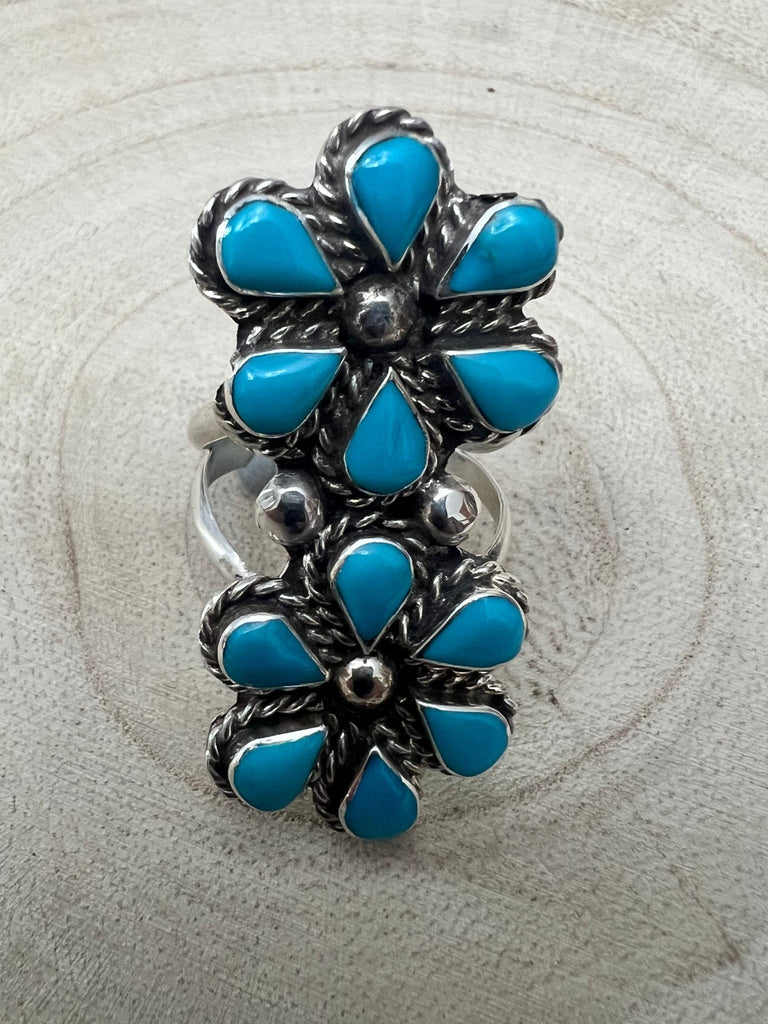
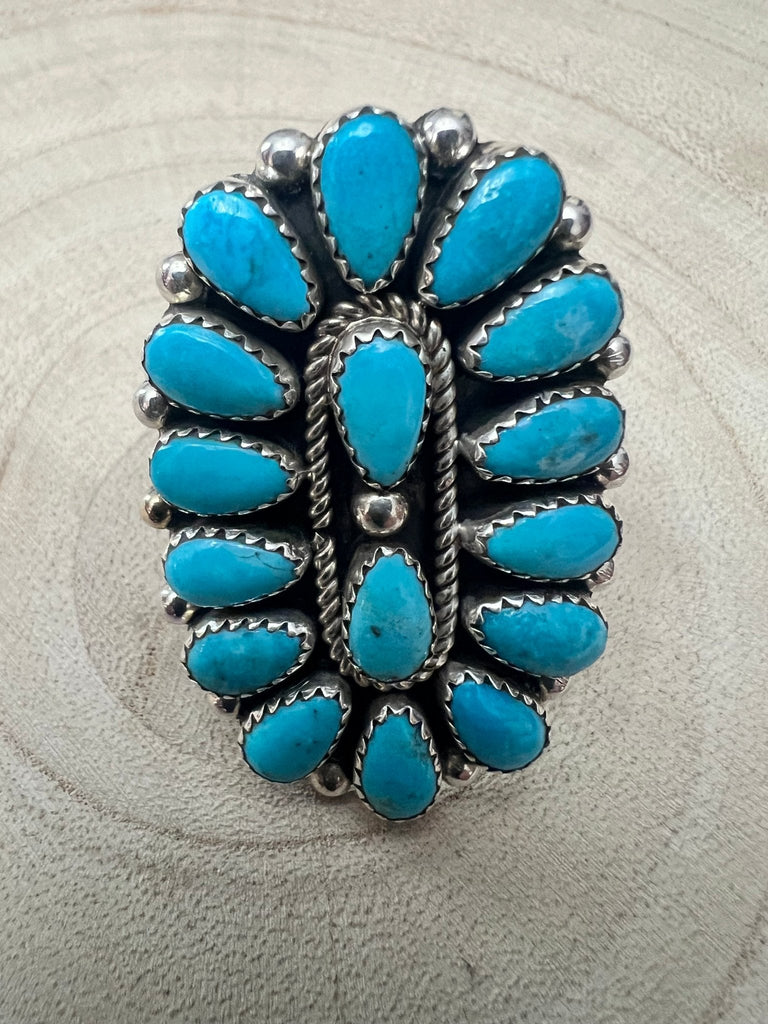
- Eunise Wilson Navajo Sterling Silver Ring with Turquoise, Size 8 ($374): Hallmark EJW and Sterling, a three-letter initial mark. A bold cluster ring measuring 1 5/8″ × 1 1/8″.
- Randy Billy Navajo Sterling Silver Ring with Golden Hills Turquoise, Size 9 ($235): Hallmark RB and Sterling. Face 5/8″ × 5/8″.
- Randy Billy Navajo Sterling Silver Ring with Royston Turquoise, Size 9.5 ($269): This one is stamped with the full name “Randy Billy” plus Sterling. Face 3/4″ × 3/4″.
- Randy Boyd Navajo Sterling Silver Ring with Fox Turquoise, Size 8.5 ($266): Hallmark RB and Sterling, the same initials as Randy Billy from a different maker. 1 1/4″ × 3/4″.
- Anthony Brown Navajo Sterling Silver Bracelet with Kingman Turquoise ($899): Hallmarked with a short name, “Anthony B,” plus Sterling. 3/4″ wide, for about a 6 5/8″ wrist.
- Jimson Belin Navajo Sterling Silver Necklace with Kingman Turquoise ($289): The listing records the stamp as .925, a metal mark, with the maker named on the listing. 16″ chain; pendant 1 1/8″ × 1 5/8″.
Our listings don’t state gram weights or whether each stone is natural or stabilized. Ask us if that matters for your purchase. For stone background, see Kingman vs Sleeping Beauty turquoise and our Turquoise Buyer’s Guide.

Browse more signed work in our Authentic Native Jewelry collection or our sterling silver rings. To keep stamps legible, clean gently and skip harsh dips. Our guide on how to clean turquoise jewelry explains how.
A hallmark names the maker, but the style can hint at the tradition too. See our guide to telling Navajo, Zuni and Hopi jewelry apart, from heavy stamped silver to Zuni needlepoint and Hopi overlay.
Key facts: Navajo hallmarks
- A Navajo hallmark is the maker’s mark: usually stamped initials, a name or a symbol on the back or inside of a piece.
- STERLING and .925 are metal marks. Sterling means at least 925/1,000 silver under 16 CFR 23.5. They don’t identify the maker.
- The Indian Arts and Crafts Board stamped approved silver U.S. NAVAJO or U.S. ZUNI plus a trader number from 1938 to about 1943.
- Personal hallmarks spread from the 1940s. Most Southwest Native silver made before 1950 is unsigned.
- Initials are shared and named marks have been forged, so a hallmark is a lead, not proof.
- Trading-post and guild marks identify a business or organization, not the individual smith.
- The best proof is a written record of the maker and their tribal affiliation from the seller.
Frequently asked questions
Can two Navajo artists have the same hallmark?
Yes. Short initials are often shared. Reference guides note that “F.P.” alone has been recorded for several different smiths. In our own shop, Navajo silversmiths Randy Billy and Randy Boyd both stamp “RB.” Compare the full mark, its shape and the style of the piece, and rely on the seller’s written attribution.
Where is the hallmark on a Navajo ring?
Usually on the inside of the band, often next to a STERLING or .925 stamp. On wide or heavy rings it can also be on the back of the setting. Look under angled light with a magnifier, because worn or shallow stamps are easy to miss.
What does “U.S. NAVAJO” stamped on jewelry mean?
It is a mark from a government program run by the Indian Arts and Crafts Board from 1938 to about 1943. Approved handmade silver was stamped U.S. NAVAJO or U.S. ZUNI plus a number for the trader, school or guild that submitted it. It does not name the individual maker.
Where can I look up a Navajo hallmark?
The standard printed reference is Bille Hougart’s Native American and Southwestern Silver Hallmarks, now in its fifth edition. Some Southwest dealers also publish free online hallmark directories. Treat any match as a lead, then ask the seller for the maker’s name and tribal affiliation in writing.
Is a Navajo piece without a STERLING stamp not real silver?
Not necessarily. Many older pieces carry no stamps at all, and early Navajo silver was made from melted coins. But an unmarked piece shouldn’t be assumed to be sterling either. Ask the seller to state the metal in writing. Nickel silver contains no silver and shouldn’t be sold as silver.
Hallmarked Navajo silver, named makers
Shop signed Navajo and Native-made turquoise jewelry from Leather Stone Jewels in Fort Worth, TX, with the artist and hallmark on the listing. Orders ship in 24–48 hours, US shipping is free on orders over $50, and returns are accepted within 7 days in original condition. Use code WELCOME10 for 10% off your first order.
See how we represent hallmarks and Native-made pieces on our Authenticity Guarantee page before you purchase.
See how we represent hallmarks and Native-made pieces on our Authenticity Guarantee page before you purchase.