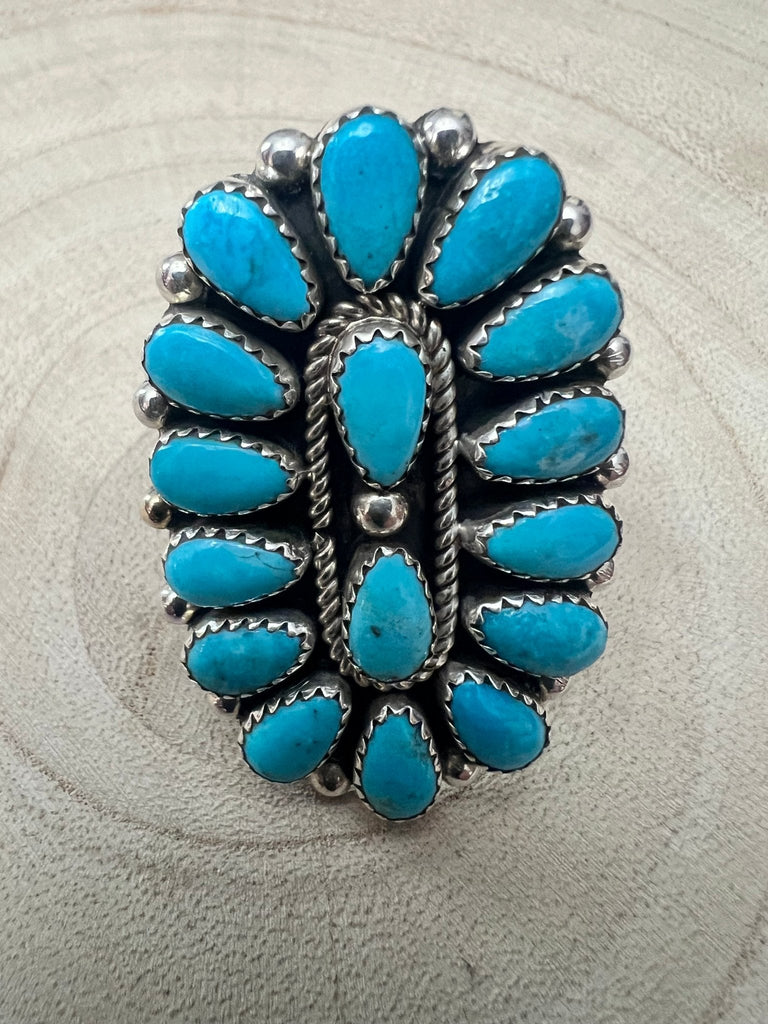
Turquoise Buyer's Guide: How to Buy Turquoise Jewelry With Confidence
Quick answer: To buy turquoise jewelry with confidence, ask the seller in writing whether the stone is natural, stabilized, reconstituted, dyed or imitation, and which mine it came from. Then judge color, matrix and hardness, check for .925 sterling marks, and get any “Native American made” claim written on your receipt.
Updated October 25, 2026
Turquoise is one of the few gems where two stones that look alike at arm’s length can differ enormously in value. The difference usually comes down to three things: whether the stone has been treated, where it was mined, and who made the piece. This guide walks through each one, using the same standards the U.S. Federal Trade Commission (FTC), the Indian Arts and Crafts Board and the Gemological Institute of America (GIA) use, so you know what to ask before you buy.
What is turquoise, and why does it vary so much?
Turquoise is a hydrated copper aluminum phosphate. Copper gives it the blue, and iron pushes it toward green. It sits around 5 to 6 on the Mohs hardness scale, which makes it softer than quartz. Many turquoise stones are also porous. That porosity is the root of almost everything a buyer needs to know: soft, chalky turquoise can absorb oils and dyes, crumble when cut, and change color over time. That’s why so much of the market is treated.
The FTC describes turquoise as “a copper mineral, often containing small brown or gray veins” that “ranges in color from sky blue to greenish-blue and varies in hardness from soft/somewhat porous to hard.” Those veins are called matrix: the host rock the turquoise formed in. Depending on the mine, matrix can be black, brown, golden or reddish, and it can form a fine web pattern, known as “spiderweb.”
How is turquoise graded and valued?
According to GIA, turquoise is judged on three basic qualities: color, texture and the presence or absence of matrix. GIA notes that the most prized color is an even, intense, medium blue, though plenty of buyers and designers prefer greenish-blue or even lime and avocado green. In practice, value is driven by:
- Color: Saturated, even blue usually commands the most, but rare greens from certain mines are highly collectible.
- Hardness and texture: Hard, dense stone takes a high polish and resists color change. Soft, chalky stone usually needs treatment.
- Matrix: Clean stone and tight, attractive spiderweb matrix both carry premiums. Blotchy or crumbling matrix lowers value.
- Treatment: Natural, untreated stone of gem quality is worth far more than stabilized stone from the same mine.
- Origin: A documented American mine, especially one that has closed, adds collector value.
- Maker and craftsmanship: Signed, hand-fabricated silverwork by a known artist can be worth more than the stone itself.
Natural, stabilized, reconstituted or dyed howlite: what’s the difference?
This is the single most important question to ask. Under the FTC’s Guides for the Jewelry, Precious Metals, and Pewter Industries (16 CFR Part 23), sellers should tell you if a stone has been treated when the treatment isn’t permanent, creates special care requirements, or significantly affects value. Here is how the main categories compare:
| Type | What it is | Is it real turquoise? | Relative value | Clues |
|---|---|---|---|---|
| Natural | Cut and polished only, with nothing added | Yes | Highest | Usually hard, high-grade stone; may darken slowly with wear |
| Stabilized | Soft or medium-grade turquoise impregnated with clear resin or acrylic to harden it | Yes, treated | Moderate | Very even color and a slightly glassy or plastic-like luster. The FTC says most turquoise used today is stabilized. |
| Enhanced / color-treated | Stabilized with added color, or dyed to deepen blue | Yes, treated | Lower | Color that is unnaturally uniform, or that concentrates in cracks |
| Reconstituted | Turquoise powder mixed with epoxy and pressed into blocks | Partly. It contains turquoise but is not a natural stone. | Low | Repeating patterns, flat color, often a very low price |
| Dyed howlite / magnesite | A different white mineral dyed blue to imitate turquoise | No. It’s an imitation. | Lowest | White showing in chips or drill holes, and dye pooling in the veins |
| Block / plastic / glass | Fully man-made material | No | Fashion only | Lightweight, warm to the touch, mold seams. Should be sold as “Imitation Turquoise.” The FTC says “faux” alone isn’t an adequate label. |
Stabilized turquoise isn’t “fake.” It’s real turquoise made durable enough to wear every day, and it can be a smart buy at the right price. The problem is only undisclosed treatment. If a price seems far too low for “natural” stone, ask for the treatment in writing.
Want the full picture on treatments? Our guide to stabilized vs natural turquoise compares natural, stabilized, enhanced, reconstituted and Imitation Turquoise side by side, and explains how labs tell them apart and what a seller should put in writing.
Which turquoise mines matter most?
Turquoise is often sold by mine name, and some names carry real premiums. The FTC and Indian Arts and Crafts Board brochure notes that use of turquoise from other countries is common. A mine name is a claim, so ask how the seller knows it. Here is how several well-known American types compare:
| Type | Origin | Typical color | Matrix | Buyer notes |
|---|---|---|---|---|
| Kingman | Mineral Park area near Kingman, Arizona | Sky to deep blue | Black or brown; can be spiderweb | One of the best-known U.S. sources. Much Kingman is stabilized, so natural high-grade costs more. |
| Sleeping Beauty | Globe, Arizona | Even, robin’s-egg blue | Little to none | The mine stopped turquoise production in 2012, so supply is now limited to existing stock. Widely used in heishi and inlay. |
| Royston | Royston district, Nevada | Blue, green and mixed blue-green in one stone | Golden brown to dark brown | Prized for color variety within a single stone. Popular in collector silverwork. |
| Number 8 | Eureka County, Nevada | Blue to blue-green | Golden-brown to black spiderweb | A historic, largely mined-out source. Fine spiderweb stones are highly collectible, so ask for provenance. |
| Lone Mountain | Nevada | Deep blue | Black spiderweb or clean | A high-grade collector stone with limited supply. |
| Hubei | Hubei Province, China | Blue to green | Often dark spiderweb | A long-standing source with grades from commercial to high-grade. Not “lesser” by default. |
Torn between the two best-known Arizona blues? Our side-by-side guide to Kingman vs Sleeping Beauty turquoise compares their mines, color, matrix, treatment and value, and explains why a mine name alone can’t prove where a stone came from.
How can you tell if turquoise is real?
There’s no reliable at-home test that is safe for the stone. Hot-needle and acetone “tests” can damage good turquoise and still give false results. Use these low-risk checks instead, and rely on a qualified gemologist for anything valuable:
- Look at the matrix. Natural matrix sits at the stone’s surface level or slightly recessed. Dye that pools in cracks, or a pattern that repeats from stone to stone, is a warning sign.
- Check drill holes and chips. White showing inside a bead’s hole often points to dyed howlite or magnesite.
- Weigh the price against the claim. “Natural Sleeping Beauty” or “Number 8” at costume-jewelry prices doesn’t add up.
- Ask for disclosure in writing. A reputable seller will state natural, stabilized or other treatment on the listing or receipt.
- Get a lab report for high-value pieces. Gem labs such as GIA can identify turquoise and detect many treatments and imitations.
Want to go further than these quick checks? Our step-by-step guide on how to tell if turquoise is real explains what the hot needle, acetone, scratch and UV tests actually prove, and when a lab report is worth it.
What does the Indian Arts and Crafts Act mean for buyers?
The Indian Arts and Crafts Act of 1990 is a truth-in-advertising law. It makes it illegal to offer or display for sale any art or craft product in a way that falsely suggests it is Indian-produced, an Indian product, or the product of a particular Indian tribe. For a first violation, an individual can face a fine of up to $250,000, up to five years in prison, or both, and a business can be fined up to $1,000,000. A joint FTC and Indian Arts and Crafts Board brochure explains that for an item to be called an “Indian product,” all the work on it must have been done by an Indian or Indians.
For buyers, that means:
- “Native American style,” “Southwest style” or “Navajo-inspired” describes a look, not a maker.
- For Native-made claims, look for the artist’s name, tribal affiliation and hallmark, and ask for them in writing.
- The FTC advises getting written proof of authenticity claims, making sure claims such as “sterling silver and natural turquoise, handmade by an American Indian artisan” appear on your receipt, and paying by credit card for dispute protection.
- Suspected violations can be reported to the Indian Arts and Crafts Board (1-888-ART-FAKE).
What should you check in the silver and setting?
Under FTC rules, jewelry marked “sterling” or “925” should be at least 92.5% silver. Look for a .925 or “Sterling” stamp, and on artist pieces, a hallmark. Then check the craftsmanship:
- Bezels: These should hug the stone evenly, with no gaps or glue overflow. Rope-twist or serrated bezels are a sign of hand fabrication.
- Back plate and solder joints: These should be clean and solid. Heavy-gauge silver feels substantial.
- Hand-fabricated vs. cast: Stampwork, applied silver details and oxidized recesses usually mean hand fabrication. Cast pieces can be beautiful too, but they are typically priced lower.
- Fit: Adjustable rings and extenders matter if you can’t try the piece on before buying.
Buyer’s tip from Leather Stone Jewels
Read the whole product description, not just the title. The details that decide value, like the stone type, mine name, “natural” wording, maker, silver content and exact measurements, are usually in the body text. If something you care about isn’t listed, ask before you buy. With our 7-day return window, you can also see the stone in person in natural light and decide whether it’s right for you.
Which turquoise pieces show these buying points?
Here are real pieces from our shop that illustrate the points above. Each detail below comes from its product listing:
- Heritage Series Kingman Turquoise Chandelier Huggie Earrings ($495): Hand-fabricated sterling silver set entirely with natural Kingman turquoise, with teardrop centers, smaller Kingman accents and an oxidized finish. By Bootleg Silver Co.
- Heritage Series Royston Turquoise Statement Ring, Size 7.25 ($450): Multiple natural Royston stones with visible matrix across a broad rectangular face, plus textured, openwork sterling silver. A good example of Royston’s color range.
- Heritage Series Kingman, Royston & Orville Jack Turquoise Statement Necklace ($1,795): An approximately 2″ × 2″ heavy-gauge sterling pendant that combines three American turquoise sources in blues and greens.
- Teardrop Premium Black Jack Turquoise Sterling Silver Necklace ($199): A teardrop cabochon of natural premium Black Jack turquoise with brown/black matrix, a rope-twist bezel and a 20″ sterling oval-link chain, handmade in our Fort Worth studio.
- MJ Blue Turquoise Adjustable Ring ($225): Genuine blue turquoise with natural matrix in solid .925 sterling silver, about 1½″ × 1¼″. Adjustable, one of a kind and made in the USA by MJ for The Bijoux FAB.
- Matrix Turquoise Bracelet, 6¼″, 5mm Oval ($75): Matrix-rich 5mm turquoise oval beads with sterling silver findings and an extender, handmade in North Texas. An easy entry point.
Browse more in our Black Jack Turquoise collection and our Authentic Native Jewelry collection. For any piece described as Native-made, look for the artist and maker details in that item’s listing.
How do you care for turquoise jewelry?
- Put turquoise on after lotion, perfume and hairspray. GIA notes that turquoise can absorb chemicals and cosmetics, which can affect its color.
- Expect natural, porous turquoise to darken gradually as it absorbs skin oils. Many collectors value this patina.
- Clean with a soft, dry or slightly damp cloth. Avoid ultrasonic and steam cleaners, and silver dips that touch the stone.
- Store pieces separately so harder gems and metal don’t scratch the stone, and take them off for swimming, dishwashing and the gym.
Key facts about buying turquoise
- Turquoise is a copper aluminum phosphate, about 5–6 on the Mohs hardness scale, and often porous.
- GIA judges turquoise on color, texture and matrix. Even, intense medium blue is traditionally the most prized color.
- The FTC says most turquoise used today is stabilized, and that sellers should disclose treatments that are not permanent, require special care or significantly affect value.
- Reconstituted turquoise is turquoise powder bound with epoxy. Dyed howlite and magnesite are imitations, not turquoise.
- The Sleeping Beauty mine in Arizona stopped turquoise production in 2012.
- The Indian Arts and Crafts Act of 1990 bans marketing products in a way that falsely suggests they are Indian-made.
- “Sterling” or “925” jewelry must be at least 92.5% silver.
- Get every authenticity, treatment and origin claim in writing on your receipt.
If you prefer a petite, everyday piece, our hand-stamped sterling silver turquoise ring in size 5 shows how traditional stamping frames a turquoise stone.
Wondering how to wear your turquoise once you’ve bought it? Our western jewelry style guide covers necklines, layering lengths, cuff stacking and how to build an outfit around one piece.
Frequently asked questions
Is stabilized turquoise fake?
No. Stabilized turquoise is genuine turquoise that has been impregnated with clear resin to make it harder and more color-stable. The FTC notes that most turquoise used today is stabilized. It should be disclosed, and it is generally priced below natural gem-quality stone.
What is the most valuable type of turquoise?
Natural, untreated, hard, high-grade stone with documented origin, such as Lone Mountain, Number 8 or high-grade Kingman, tends to command the highest prices. GIA notes that pricing is based primarily on quality rather than origin, so color, matrix and hardness come first, and the maker’s reputation matters too.
How can I tell if turquoise is dyed howlite?
Look for white showing in drill holes or chips, dye collecting in the veins, and very uniform color at a very low price. Dyed howlite isn’t turquoise and should be sold as Imitation Turquoise. For a valuable piece, ask a gemologist or a lab to confirm.
Does turquoise change color over time?
It can. GIA notes that porous turquoise can gradually darken as it absorbs skin oils, and that it can also absorb cosmetics and cleaning products. Stabilized turquoise is more resistant to this. Putting jewelry on after lotion and perfume helps preserve its color.
How do I know if turquoise jewelry is really Native American made?
Look for the artist’s name, tribal affiliation and hallmark, and ask the seller to put the claim in writing on your receipt, as the FTC advises. Under the Indian Arts and Crafts Act, it is illegal to market a product in a way that falsely suggests it is Indian-made.
Related guides
- How to Tell if Turquoise Is Real: 8 Checks, Tests and Red Flags
- Kingman vs Sleeping Beauty Turquoise: How to Tell Them Apart
- Stabilized vs Natural Turquoise: What’s the Difference?
Find your piece of the West
Shop turquoise, leather and sterling silver jewelry from our Fort Worth, TX shop. Orders ship in 24–48 hours, US shipping is free on orders over $50, and you have 7 days for returns. Use code WELCOME10 for 10% off your first order.
Bought your turquoise? Keep it looking its best with our step-by-step guide on how to clean turquoise jewelry, including care for natural, stabilized and dyed stones, tarnished silver, leather settings, and the cleaners you should never use.
Shopping for Native-made turquoise? Our Navajo jewelry guide explains Navajo silversmithing history, stamping, casting and cluster work, squash blossoms and concho belts, how to read hallmarks, and what the Indian Arts and Crafts Act means for buyers.
Boutique buyers can also review wholesale turquoise jewelry and our silver-plated starter package from Fort Worth.