Navajo vs Zuni vs Hopi Jewelry: How to Tell Them Apart
Quick answer: Navajo jewelry is silver-forward, with heavy stamped or cast silver and large turquoise stones. Zuni jewelry is stone-forward, with many small, precisely cut stones in inlay, needlepoint or petit point. Hopi jewelry is best known for silver overlay, a cutout silver layer over a darkened background. Style suggests a tradition, but only the documented maker proves which tribe made it.
Navajo, Zuni and Hopi artists live close to one another in the Southwest, share many materials and have traded ideas for more than 150 years. That’s why their jewelry gets mixed up so often, by buyers and sometimes by sellers. This guide explains the visual signs of each tradition, the history behind them, where the styles overlap and how to confirm who actually made a piece. For background on Navajo silver in depth, start with our Navajo jewelry guide.

What is the quickest way to tell Navajo, Zuni and Hopi jewelry apart?
Ask one question: what is the star of the piece? The Museum of Northern Arizona, whose gallery holds about 170 pieces by Hopi, Zuni, Navajo and Rio Grande artisans, describes the same broad split most experts use. Navajo smiths are known for silver, Zuni artists for stonework and Hopi artists for overlay.
| Navajo (Diné) | Zuni (A:shiwi) | Hopi | |
|---|---|---|---|
| What leads the design | Silver: weight, stamping and casting | Stones: precise cutting and setting | Silver: cutout designs in two layers |
| Signature techniques | Stamping, sand and tufa casting, repoussé, large bezel-set stones | Inlay, channel inlay, needlepoint, petit point, carved fetishes | Silver overlay with an oxidized, textured background |
| Typical stones | Turquoise in large natural-shaped cabochons; also coral | Turquoise, coral, jet, mother of pearl, shell, cut into small uniform shapes | Often none; small stones as accents |
| Classic pieces | Squash blossom necklaces, concho belts, heavy cuffs, ketohs (bow guards), buckles | Needlepoint and petit point cluster pieces, inlaid pendants and bolos, fetish necklaces | Overlay cuffs, rings, belt buckles and bolos with pottery-inspired motifs |
| When silversmithing began | Mid-1800s, learned from Mexican plateros | Around 1872, learned from a Navajo smith | 1890s; overlay style from the late 1930s and after WWII |
| Quick visual cue | Bold silver with a big stone | Many small stones, often matching | Black-and-silver graphic design, few stones |
Treat the table as a starting point, not a rule. Each tradition has artists who work outside its classic style, and the techniques themselves aren’t owned by any one tribe.
What does Navajo jewelry look like?
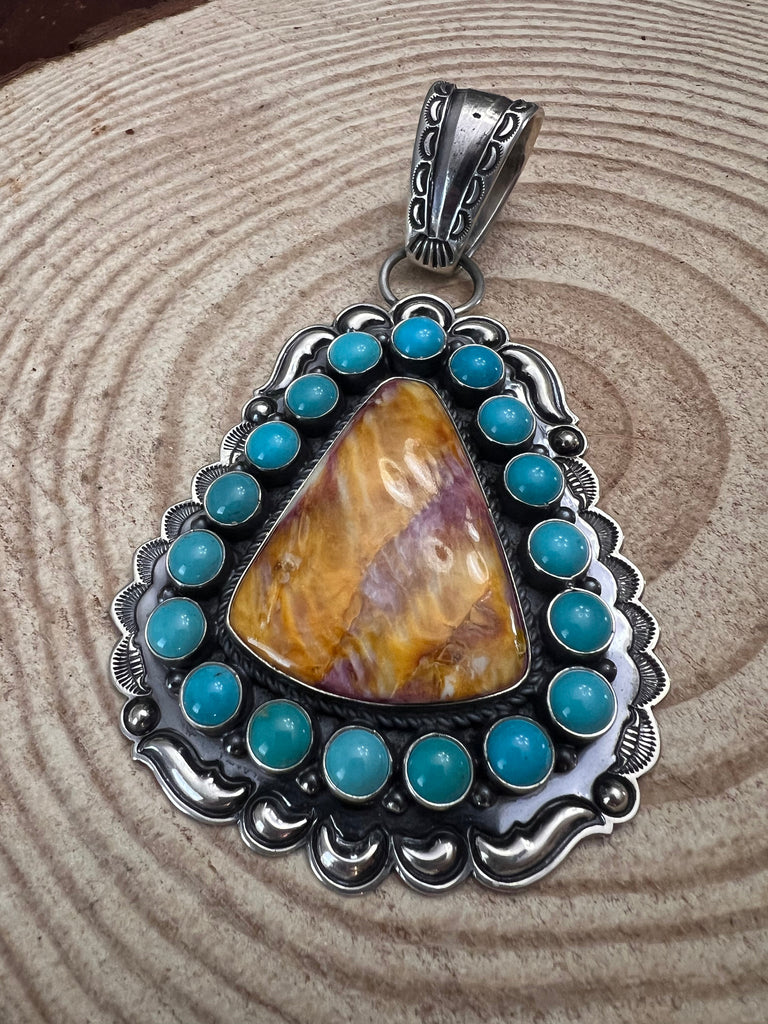
Navajo (Diné) jewelry puts silver first. The Museum of Northern Arizona notes that Navajo jewelers learned to stamp, hammer, cast and solder silver from plateros, Hispanic New Mexican silversmiths, in the 1800s. Classic Navajo pieces include squash blossom necklaces, concho belts, heavy men’s bracelets, belt buckles set with large turquoise stones and ketohs, or bow guards. The Heard Museum describes Diné jewelry as “a mastery of silverwork combined with dramatic stones from the many varieties of turquoise.”
Signs of classic Navajo work:
- Thick sterling silver with stamped decoration, often suns, arrows or crescents.
- Sand-cast or tufa-cast silver with a slightly textured, organic surface.
- One or a few large turquoise cabochons, often left in their natural, irregular shape.
- Serrated or smooth bezels, twisted wire and small silver drops framing the stones.
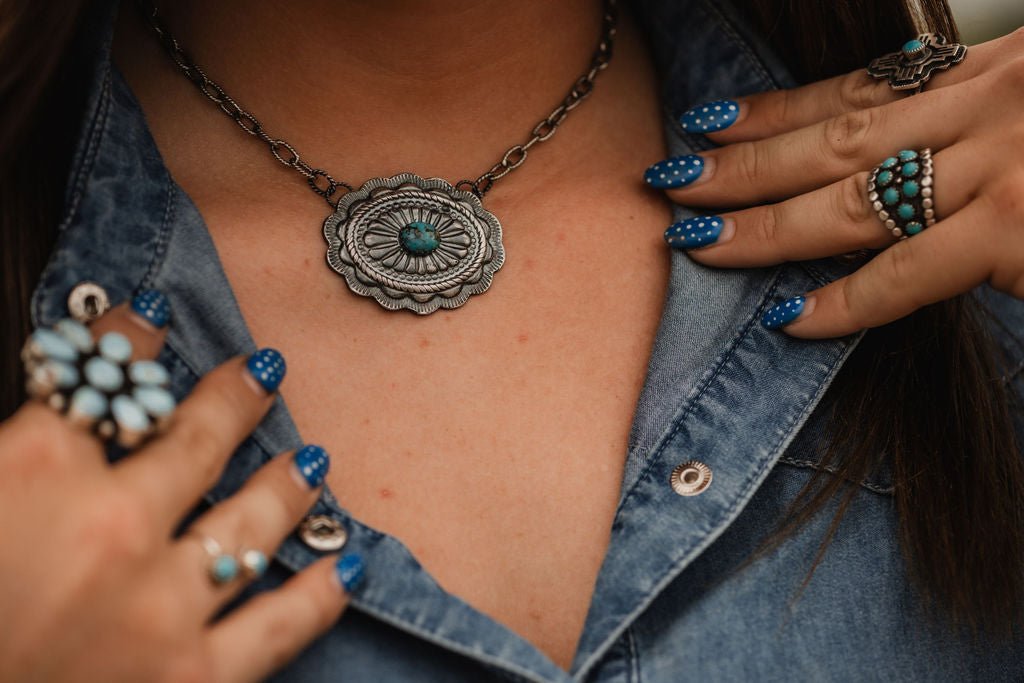
Navajo artists also make cluster work. Navajo silversmith Philena Byjoe’s cluster ring in our shop is a good example of how the styles overlap. To identify the maker’s stamp on a Navajo piece, see our guide to Navajo hallmarks.
What does Zuni jewelry look like?
Zuni (A:shiwi) jewelry puts the stones first. The Museum of Northern Arizona says Zuni artists specialize in inlaid stone patterns using turquoise, mother of pearl, shell, coral, lapis, jet and onyx, and are known for delicate needlepoint and petit point. The Heard Museum calls intricate lapidary work Zuni jewelry’s “most striking feature,” including mosaic patterns, needlepoint and animal fetish necklaces.
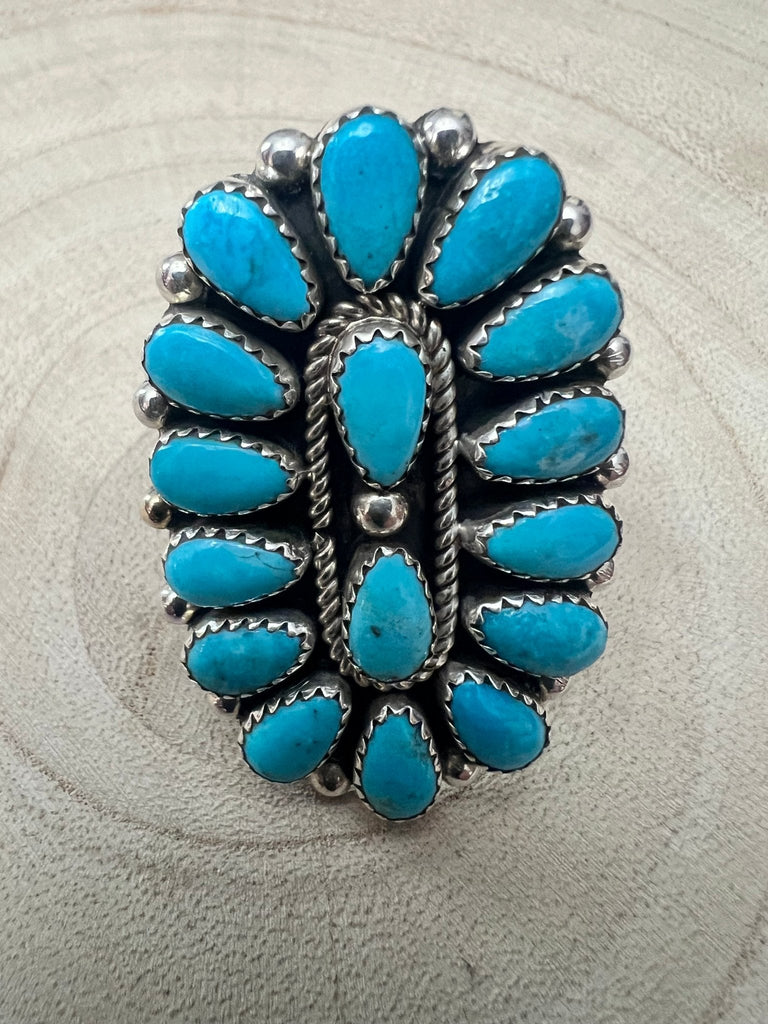
- Petit point: many small round, oval or teardrop stones, each in its own bezel, arranged in clusters or rows.
- Needlepoint: even thinner stones cut into long, pointed needle shapes, set side by side.
- Inlay (mosaic): stones and shell cut to fit tightly together and ground flush into one smooth surface, often forming birds, kachina-style figures or animals.
- Channel inlay: stones set into small cells formed by upright silver strips. Arizona Highways reported that dealers agree the technique appeared at Zuni around 1940.
- Fetish carvings: small carved animals, often strung as necklaces.
The silver in Zuni work is usually lighter and plainer, because its job is to hold the stones.

What does Hopi jewelry look like?
Hopi jewelry is best known for silver overlay. The artist cuts a design out of one sheet of silver, solders it onto a second solid sheet, and then darkens and often textures the exposed background. The Lam Museum of Anthropology explains that the top sheet is polished while the bottom is left to oxidize into a dark patina, which makes the design stand out in black and silver.
Look for:
- A two-layer edge when you view the piece from the side.
- Graphic motifs adapted from traditional Hopi pottery, basketry and carvings.
- Little or no stone. When stones appear, they are usually small accents.
- A textured, darkened background inside the cutouts.
Before overlay, early Hopi silver looked much like Navajo work, and the Lam Museum notes it was often hard to tell the three tribes’ silver apart.
How did each tradition develop its own style?
The three styles grew from the same roots and then pulled apart:
- Navajo, mid-1800s: Navajo smiths learned silverwork from Mexican plateros and developed stamping and casting traditions (MNA).
- Zuni, about 1872: In an account recorded by anthropologist John Adair in the 1930s, Zuni silversmith Lanyade said a Navajo smith named Atsidi Chon taught him, making him the first Zuni to work silver (Southwest Crossroads). Early Zuni silver closely resembled Navajo work before Zuni artists focused on stone cutting.
- Hopi, 1890s to 1949: Silversmithing reached the Hopi in the 1890s. In the late 1930s, Museum of Northern Arizona founder Mary-Russell Ferrell Colton urged Hopi smiths to make work that was “absolutely unique” (Sharlot Hall Museum). After World War II, Fred Kabotie and Paul Saufkie taught overlay to Hopi veterans under the GI Bill from 1947. The first class of fifteen graduated in 1949, the year Kabotie helped found the Hopi Silvercraft Cooperative Guild (MNA archive; University of Arizona).
Where do the styles overlap?
This is the part most comparison guides skip, and it’s why style alone can mislead you:
- Artists cross styles. Navajo silversmiths make cluster and petit point work, and some Zuni artists make bold silver pieces.
- Shared work happened. T.Skies cites jewelry historians describing early channel pieces where a Navajo smith made the silver and a Zuni jeweler set the stones.
- Overlay isn’t exclusive. The Heard Museum notes that “today, jewelers from any culture may choose to use this technique.”
- Imitations copy all three. Mass-produced “Southwest style” jewelry imitates each look, often with imitation turquoise or plated metal.
Other Pueblos have their own traditions too. Kewa (Santo Domingo) Pueblo, for example, is famous for heishi beads and mosaic work, so not every Native piece fits these three categories.
How do you confirm who made a piece?
- Look at what dominates the piece. If the silver is the star, with heavy stamping, casting or one or a few large stones, the style is classic Navajo. If the stones are the star, cut into many small matching shapes or set flush in a mosaic, the style is classic Zuni. If there is little or no stone and the design is a polished silver cutout over a dark background, the style is classic Hopi overlay.
- Count and examine the stones. Dozens of tiny identical stones, each in its own bezel, point to Zuni petit point or needlepoint. Stones fitted edge to edge or in silver cells point to inlay or channel inlay. Large natural-shaped cabochons point to Navajo work.
- Check the silver construction. Hopi overlay uses two sheets of silver soldered together, so the edge of the piece shows a double layer. Navajo pieces often show stamped decoration or sand- and tufa-cast forms.
- Find the hallmark. Look inside rings and cuffs and on the backs of pendants and earrings for the maker’s mark. Many older pieces are unsigned.
- Get the maker and tribe in writing. Style only suggests a tradition. Ask the seller for the artist’s name and tribal affiliation on the listing or receipt, as the Indian Arts and Crafts Board advises.
Under the Indian Arts and Crafts Act of 1990, it is illegal to sell a product in a way that falsely suggests it was made by Native Americans or by a particular tribe. The FTC and IACB brochure warns that a product labeled “Navajo” must be made by a member of the Navajo Nation, and that words like “descent” or “heritage” don’t mean the maker is a tribal member. The IACB’s consumer tips recommend getting a receipt that lists the maker and their tribal affiliation. The board also keeps a Source Directory of Native-owned businesses.
Checking the tribe doesn’t check the stone. Test that separately with our guides on how to tell if turquoise is real and stabilized vs natural turquoise.
Buyer’s tip from Leather Stone Jewels
Don’t buy on the word “Zuni” or “Navajo” in a title alone. Look for the artist’s name in the listing. Every Native-made piece below states the tribe, names the silversmith when we have it, and says plainly when a piece is unmarked. If you want to know more about a maker before you order, ask us and we’ll tell you exactly what we know and what we don’t.
Which Navajo and Zuni pieces can you see in our shop?
These pieces are available now at Leather Stone Jewels, a Fort Worth, Texas jewelry shop. Details come from each listing:
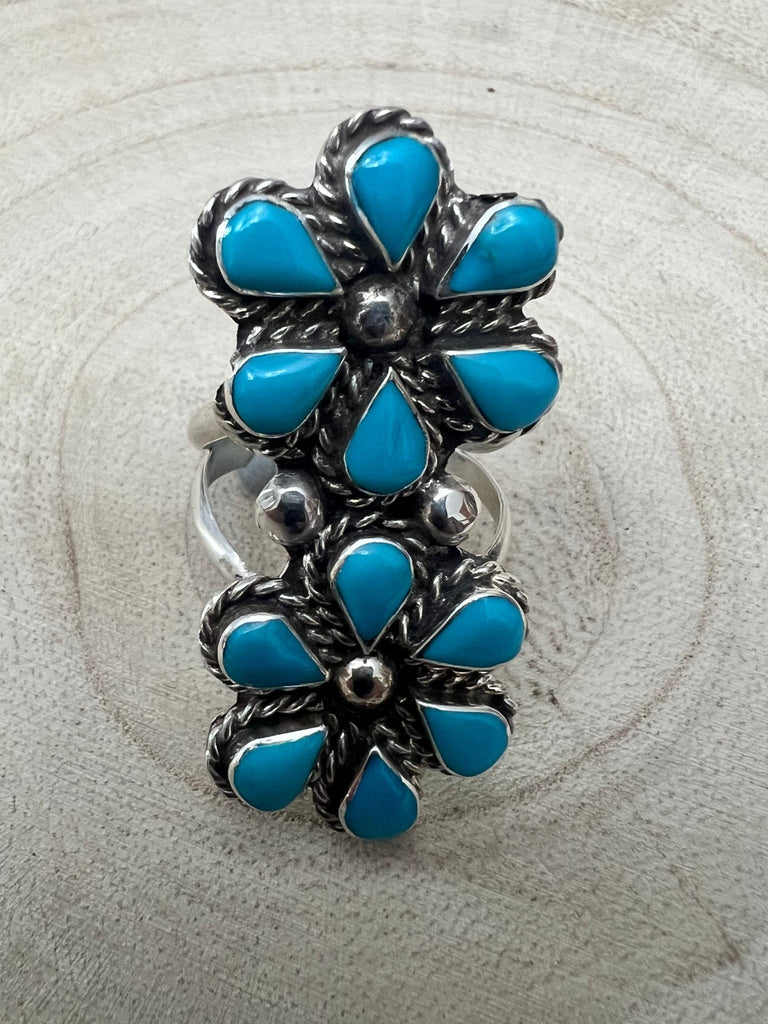
- Gina Dosedo Zuni Sterling Silver Ring with Turquoise ($288): Two flower-shaped clusters of teardrop turquoise in sterling silver, 1 5/8″ × 3/4″, sizes 7.5 and 8.5. A textbook example of Zuni cluster work.
- Sherry Nez Zuni Multi-Stone Inlay Money Clip ($89): Flush inlay of turquoise, coral, mother of pearl and onyx on sterling silver and stainless steel, 2″ × 1″.
- Reginda Kallest Zuni Owl Inlay Earrings ($155): Multi-stone and shell owl inlay in sterling silver, about 1″ long.
- 3 Stone Mini Needlepoint Turquoise Zuni Studs ($30): Three slim needlepoint turquoise stones per stud, about 10 mm × 7 mm. The listing notes no stamp, Native made, Zuni handcrafted.
- Lynette Johnson Zuni Inlay Turquoise Post Earrings ($59.99): Turquoise inlaid flush with sterling silver, 3/8″ long.
- Philena Byjoe Navajo Sterling Silver Cluster Ring, Size 8 ($999): A Navajo-made cluster ring, 2 1/4″ × 1 3/4″, hallmark PB and Sterling. Proof that cluster work isn’t only Zuni.
- Anthony Brown Navajo Sterling Silver Bracelet with Kingman Turquoise ($899): Hallmarked “Anthony B” and Sterling, 3/4″ wide, for about a 6 5/8″ wrist.
We don’t have a Hopi overlay piece in stock right now, so we haven’t pictured one here. Our listings don’t state gram weights or whether each stone is natural or stabilized; ask us if that matters to you.

Browse more in our Authentic Native Jewelry collection and our sterling silver earrings. Inlay is set with adhesive, so avoid soaking it; our guide on how to clean turquoise jewelry covers safe care. New to turquoise? Start with our Turquoise Buyer’s Guide.
Key facts: Navajo vs Zuni vs Hopi jewelry
- Navajo jewelry is silver-forward: stamped or cast sterling, often with large turquoise stones. Classic forms include squash blossoms, concho belts and heavy cuffs.
- Zuni jewelry is stone-forward: inlay, channel inlay, needlepoint, petit point and fetish carvings.
- Hopi jewelry is best known for silver overlay, a cutout silver sheet soldered over a darkened, textured silver base, developed from the late 1930s and taught to veterans from 1947.
- Zuni silversmithing began around 1872, when Navajo smith Atsidi Chon taught Lanyade.
- Styles overlap, and overlay can be made by anyone, so style suggests a tradition but doesn’t prove tribal origin.
- Proof of origin is the seller’s written record of the artist and tribal affiliation, backed by the Indian Arts and Crafts Act.
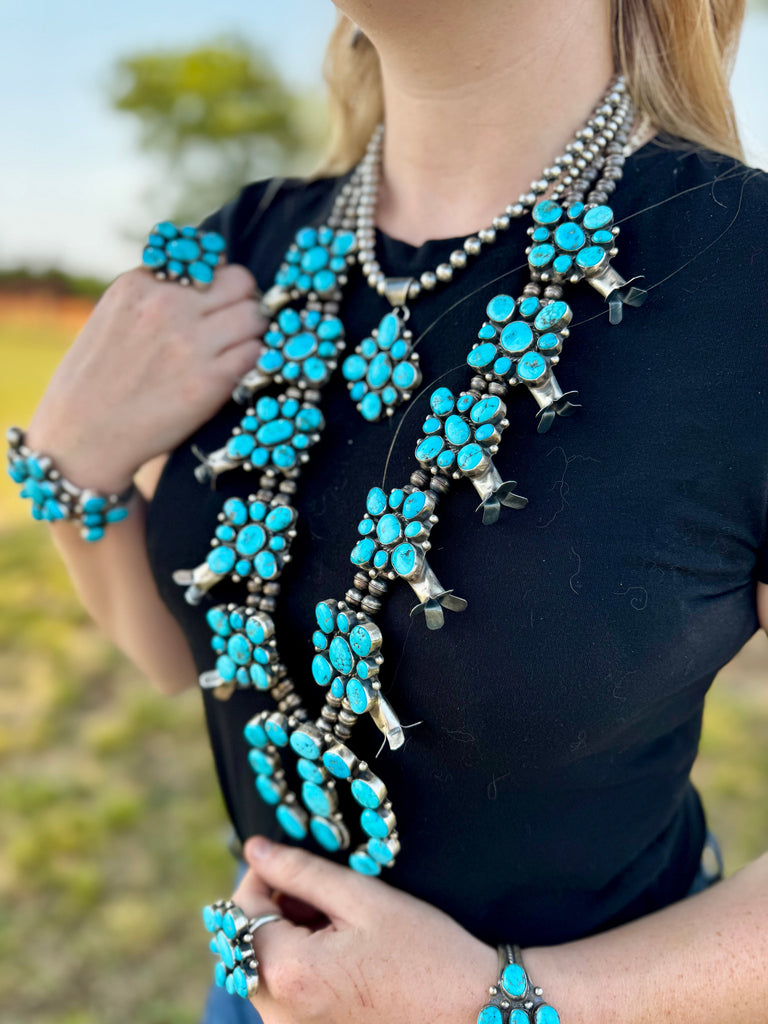
The squash blossom is the best-known Navajo form, and Zuni artists make it too. Learn its history and symbolism in our guide to squash blossom necklace meaning, from the Spanish-Moorish naja to the Diné name for the blossom bead.
Frequently asked questions
What is the main difference between Navajo and Zuni jewelry?
Navajo jewelry is silver-forward: heavy stamped or cast silver, often with one or a few large turquoise stones. Zuni jewelry is stone-forward: many small stones cut to precise shapes and set in clusters, needlepoint, petit point or flush inlay. Both use sterling silver and turquoise, and artists from both tribes sometimes work in each other’s styles.
How can you tell if jewelry is Hopi?
Most Hopi jewelry uses silver overlay: a polished silver sheet with a cutout design soldered onto a darkened, often textured, silver backing. Designs often draw on Hopi pottery and cultural imagery, and stones are rare or small. Overlay alone doesn’t prove Hopi origin, because jewelers from any culture can use the technique, so check the hallmark and the seller’s written attribution.
Is Zuni or Navajo jewelry more valuable?
Neither tribe’s work is automatically worth more. Value depends on the individual artist, the hours of labor, the quality and type of stone, the silver weight, age, condition and documentation. A complex Zuni needlepoint piece and a heavy signed Navajo cuff can both command high prices.
Does Zuni jewelry have hallmarks?
Many contemporary Zuni artists stamp a hallmark, often with STERLING or .925. Plenty of genuine Zuni pieces are unmarked, especially older or smaller ones. Two of the Zuni pairs in our shop are listed as unmarked, with the maker or Zuni origin stated on the listing instead.
Did the Navajo teach the Zuni silversmithing?
Yes, according to the account Zuni silversmith Lanyade gave anthropologist John Adair in the 1930s. Lanyade said a Navajo smith named Atsidi Chon taught him around 1872, making him the first Zuni silversmith. The Navajo themselves learned from Mexican silversmiths known as plateros.
Navajo and Zuni jewelry, named makers
Shop Native-made turquoise and silver jewelry from Leather Stone Jewels in Fort Worth, TX, with the tribe and, where known, the artist on the listing. Orders ship in 24–48 hours, US shipping is free on orders over $50, and returns are accepted within 7 days in original condition. Use code WELCOME10 for 10% off your first order.