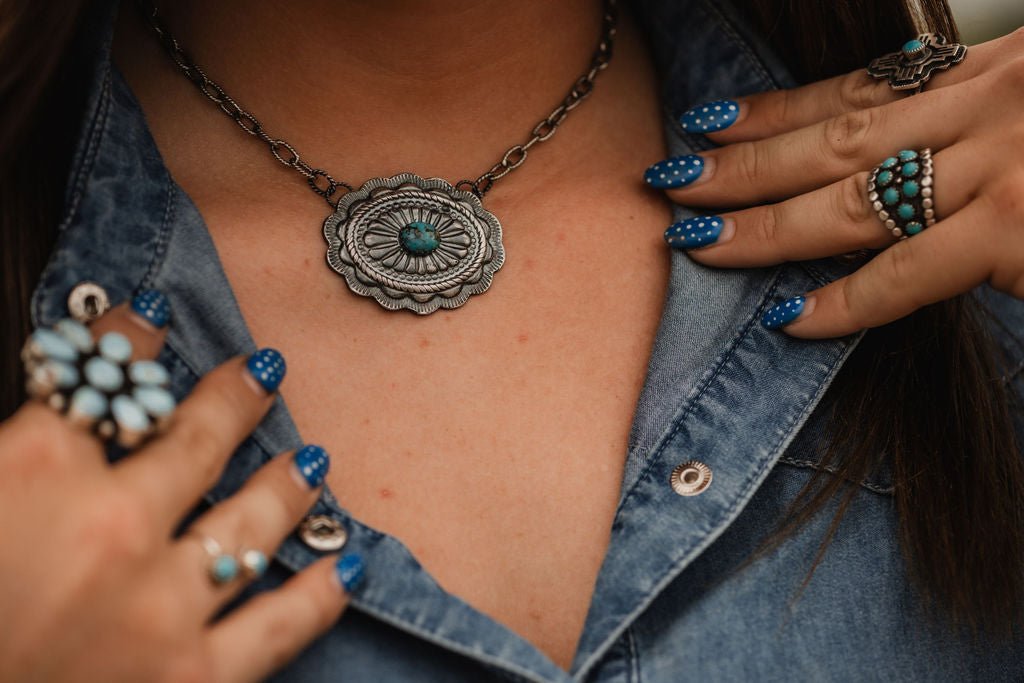
Western Jewelry Style Guide: How to Wear It, Layer It and Buy Well
Quick answer: To wear western jewelry well, let one piece lead (a cuff, concho necklace, bolo, buckle or statement earrings) and keep everything else quieter in the same metal color. Match necklace length to your neckline, space layered necklaces about two inches apart, and read the listing so you know whether it’s sterling, plated or imitation.
Western jewelry is easy to overdo. A cuff, a squash blossom, big earrings and a concho belt all at once can read as a costume. Worn with a plan, the same pieces look collected and personal. We style and sell this jewelry every day from our shop in Fort Worth, Texas, and this guide is what we tell customers at the counter: what the core pieces are, how to wear them with real clothes, and how to buy without overpaying.

What is western jewelry?
Western jewelry is the turquoise, silver, leather and concho jewelry tied to ranch and rodeo life in the American West. It draws on several traditions at once: Navajo, Zuni and other Native silverwork; Spanish and Mexican vaquero silver on saddles and bridles; rodeo buckles; and tooled leather. Today it ranges from collector pieces made by known artists to inexpensive fashion jewelry made to look the part.
Three words get mixed up, and the difference matters when you buy:
- Western describes a style: what you’d wear to a rodeo, a dance hall or the ranch.
- Southwestern describes a look and a region, usually turquoise and silver.
- Native American made is a legal claim about who made the piece. Under the Indian Arts and Crafts Act, it’s illegal to sell a product in a way that falsely suggests it’s Indian-made or the work of a particular tribe. For that side of the story, see our Navajo jewelry guide.
What are the core pieces of western jewelry?
You don’t need all of them. Most people build around two or three pieces they wear constantly. Here’s what each one is and the easiest way to start wearing it:
| Piece | What it is | Easiest way to wear it |
|---|---|---|
| Turquoise cuff | An open bracelet, usually silver, set with one or more stones | With a rolled sleeve or short sleeves so the cuff is the lead |
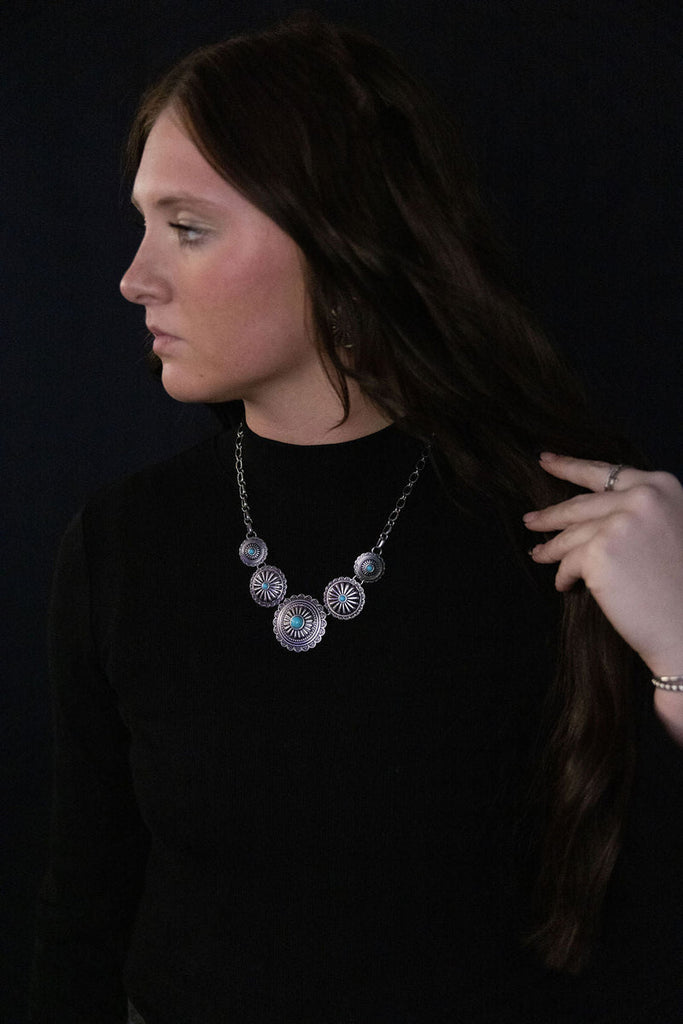
| Concho necklace or belt | Round or oval stamped silver discs, often with a stone center | A necklace in an open collar; a belt over a solid dress or a tucked tee |
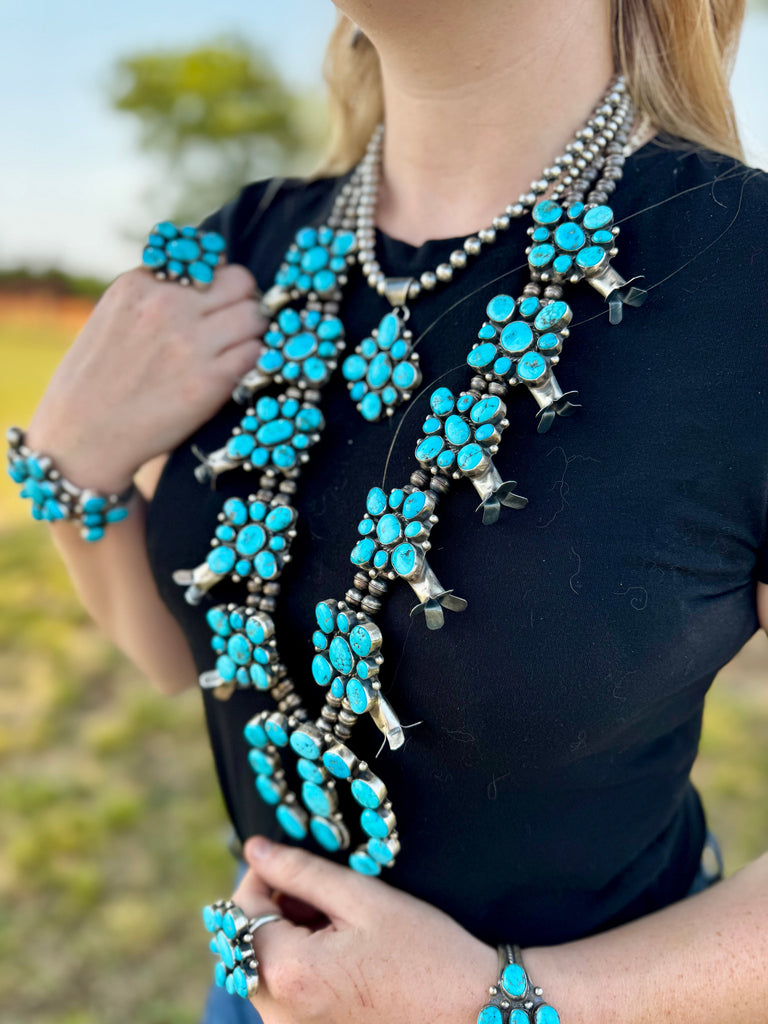
| Squash blossom or naja | A Navajo necklace form with flared “blossom” beads and a crescent pendant | Alone, over a plain dark or white top, with small earrings |
| Statement earrings | Long drops in turquoise, spiny oyster, conchos or silver | With hair pulled back and no necklace, or a very fine one |
| Bolo tie | A cord fastened by a decorative slide, worn by men and women | Snug at a buttoned collar, or loose with an open one |
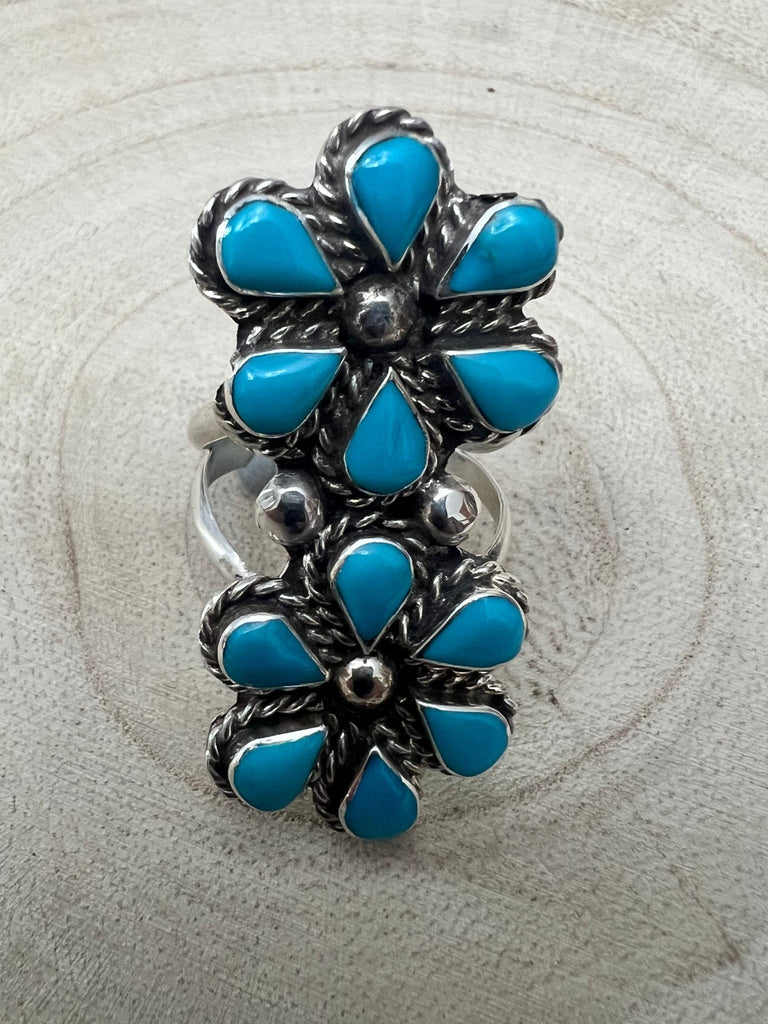
| Turquoise or silver rings | Single-stone rings, clusters and stamped bands | One bold ring per hand, with slim bands nearby |
| Leather jewelry | Leather cuffs and wraps, often set with a stone slab | Casual days and stacks; it adds warmth beside silver |
For a first piece, a cuff is the most versatile: it works with jeans, dresses and workwear, whatever the neckline.
How do you wear western jewelry without looking like a costume?
Use the one-lead rule. Choose one piece to be the first thing people notice, then add one or two smaller pieces that echo it, and leave the space around the lead quiet. A big cuff with small studs and one slim band ring looks intentional. A big cuff, big earrings and a big necklace look like they’re competing.
Your clothes count too. Embroidery, fringe, a patterned pearl-snap shirt or a trophy buckle already carry visual weight, so when the outfit is busy, go smaller or move the jewelry to the wrist.
Build an outfit in five steps:
- Pick the outfit base first. Start with the clothes you will actually wear. Denim, a solid dress or a plain tee gives jewelry room; embroidery, fringe, a big buckle or a patterned shirt already carries a lot of weight.
- Choose one lead piece. Decide where the eye should land: earrings near the face, a pendant or concho at the neckline, a cuff at the wrist, or a buckle at the waist.
- Add one or two quieter supporting pieces. Echo the lead in a smaller way, such as a slim silver band ring or small turquoise studs, in the same metal color.
- Match necklace length to the neckline. Open collars and V-necks suit pendants and conchos; crew necks suit earrings or a short piece that sits above the fabric.
- Check fit and movement. Bend your wrist, sit down and put your jacket on. A cuff should not slide over your hand or pinch, and necklaces should not catch on snaps or buttons.
Which western necklace works with which neckline?
Let the neckline choose the necklace, not the other way round. This is the quickest fix for a western outfit that feels off:
| Neckline | What works | What to skip |
|---|---|---|
| Open-collar western or denim shirt | A concho necklace, bolo or short pendant that sits inside the opening | Long layers that tangle with snaps and pockets |
| V-neck or scoop neck | Pendants, najas and squash blossoms that follow the line down | A short choker that leaves the open area empty |
| Crew neck or high neck | Statement earrings, or a short necklace sitting on top of the fabric | Long pendants that get lost in the knit |
| Off-shoulder or strapless | A short choker plus a longer pendant, or a big earring with a cuff | Several heavy necklaces at once |
| Busy print, embroidery or fringe | Smaller earrings, one ring or one cuff | Large necklaces that fight the pattern |
How do you layer western necklaces and stack cuffs?
For necklaces, use a length ladder and keep each layer about two inches apart so they don’t tangle. A simple three-layer stack might be a 16-inch strand of silver beads, an 18- to 20-inch concho or turquoise pendant as the focus, and a 24-inch chain with a small charm. Keep the longest layer the simplest, and use one bold turquoise piece, not three. If the necklace is the lead, wear small earrings.
For cuffs, build from heavy to light. Put the widest or most detailed cuff closest to the wrist bone, add a narrower one above it, and finish with something slim, such as a leather cuff or a plain silver band. Mix textures (stamped silver, a smooth stone, leather) rather than wearing three nearly identical cuffs. Turquoise in different shades, from green to sky blue, stacks well because the stones vary naturally.

Fit matters more than people expect. A cuff should slip on from the side of the wrist and sit without sliding over your hand. Bend sterling cuffs as little as possible; the Dorothy Series listing, for example, says each cuff may be adjusted once only. Our guide to Kingman vs Sleeping Beauty turquoise can help you choose stones that look good side by side.
Sterling, silver-plated or silver-tone: what are you actually buying?
Western jewelry is sold at every price point, and listings use words that sound alike but mean very different things. Under the FTC Jewelry Guides, “sterling” must be at least 92.5% silver. The same guides say an imitation stone must be clearly labeled as imitation or simulated, and that the word “faux” alone isn’t an adequate disclosure (16 CFR 23.25).
| What the listing says | What it means | What to expect |
|---|---|---|
| Sterling or .925 | At least 92.5% silver under the FTC Jewelry Guides | Durable, repairable, tarnishes over time and polishes back |
| Silver-plated | A thin silver coating over a base metal | Affordable; the plating can wear with heavy daily use |
| Silver-tone | A silver color, not a silver content claim | Fashion jewelry; buy it for the look, not the metal |
| Genuine or natural turquoise | Mined turquoise (ask whether it’s stabilized) | Each stone is different; prices vary widely by grade and source |
| Howlite, imitation or simulated turquoise | Another stone, often dyed, or a man-made material | Bold color for less money; shouldn’t be sold as turquoise |
| “Faux turquoise” | The FTC says “faux” alone isn’t an adequate disclosure | Ask what the material actually is |
Plated and imitation pieces are fine when they’re priced and labeled honestly; a sterling cuff with natural turquoise is the better buy if you’ll wear it for years. The FTC and Indian Arts and Crafts Board brochure notes that most turquoise sold today is stabilized, so ask about treatment as well. For the stone checks, read how to tell if turquoise is real and stabilized vs natural turquoise, or start with our turquoise buyer’s guide.
Buyer’s tip from Leather Stone Jewels
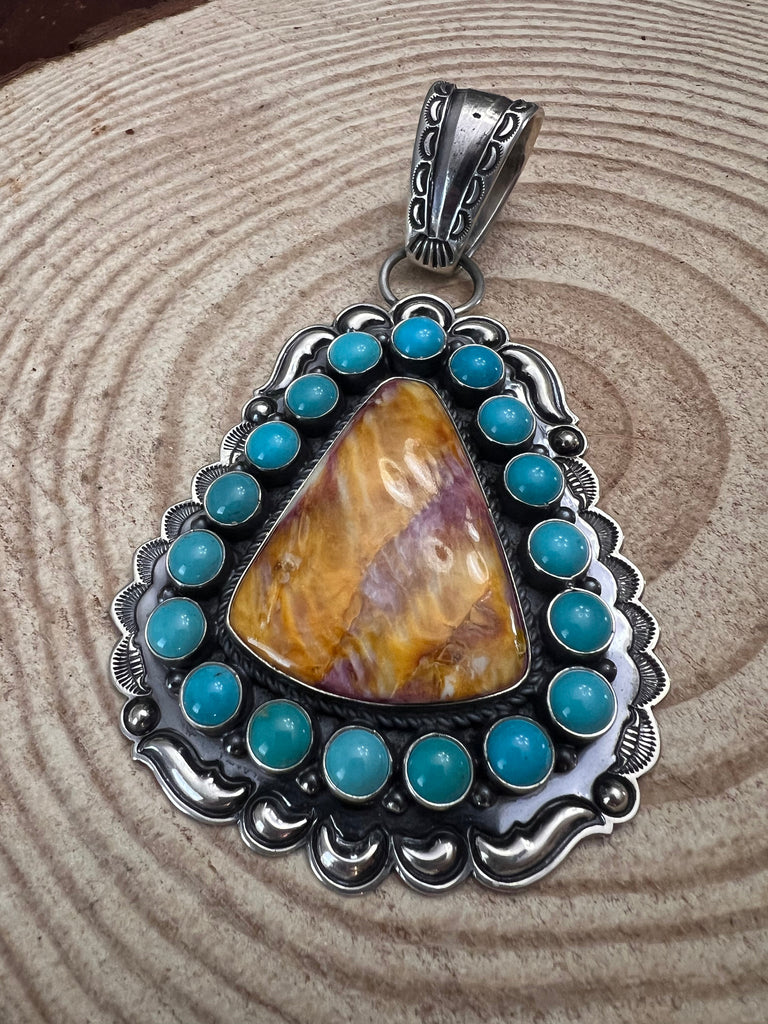
Read the details, not just the product name. Our shop carries pieces from several makers and vendors, and the name of a style can sound grander than the material list. Look for the metal (sterling, plated or silver-tone), the stone (turquoise, howlite or imitation), and the maker when one is named. Spend on the piece you’ll wear most, usually a cuff or a necklace, and save on trend pieces like belts and big earrings. If a listing doesn’t answer your question, ask us before you buy.
How should men wear western jewelry?
Start with one strong piece: a bolo tie, a cuff, a turquoise ring or a good buckle. Most men wear one or two at a time. Keep metals consistent, so a silver bolo goes with a silver ring and a silver buckle.
The bolo has real western standing. Arizona made it the state’s official neckwear in 1971, New Mexico adopted it as the official state tie in 2007, and Texas named it the official State Tie of Texas the same year. Wear it snug at a buttoned collar for church, weddings and the stock show, or slide it down with an open collar for a casual look. Men’s rings and cuffs get their own guide later in this series.

What western jewelry should you wear in Fort Worth?
Here in Fort Worth, western style isn’t a costume; it’s what people wear to work, church and the Stockyards. For a dance hall night, statement earrings or a concho necklace with a denim shirt is hard to beat. For the stock show and rodeo each winter, a cuff or turquoise ring holds up better than a long necklace under a coat, and a concho belt gives a plain dress some western shape. For the office, keep it to one piece: a slim cuff or a single concho pendant.

How do you care for western jewelry?
Put it on last and take it off first. Keep turquoise away from perfume, lotion and harsh cleaners, store pieces separately, and wipe sterling with a soft cloth while leaving the dark oxidation in stamped designs. Keep leather dry. Our guide to how to clean turquoise jewelry covers the safe methods step by step.
Which pieces should you start with?
These pieces are in stock at Leather Stone Jewels now. Details come from each listing:
- Sterling Silver Concho & Kingman Turquoise Western Statement Necklace ($499): A sterling concho with genuine Kingman turquoise on an 18-inch necklace, 1.15 oz. A lead piece for an open collar.
- Dorothy Series Sonoran Turquoise Patterned Silver Cuffs ($210–$230): Heavy-gauge sterling with natural Sonoran turquoise by Bootleg Silver Co, in sizes from petite and child-size to medium-large. Made to stack with the matching rings.
- Kingman Turquoise Large Single Stone Cuff ($64): A genuine Kingman turquoise oval in a rope-and-bead bezel on a silver-plated, open split-shank cuff. A budget-friendly lead piece.
- Narrow Leather Cuff with Blue Howlite Slab ($33): Genuine leather, 1″ × 8.5″, snaps to fit about 7.25″ to 7.75″, made in the USA. The listing’s details give the stone as blue howlite, not turquoise. A good top layer for a cuff stack.
- Desert Picture Jasper Bolo Tie ($255): Hand-fabricated by mend metalworks, with a picture jasper stone in a sterling bezel. Listed as unisex.
- Turquoise Lynx Oval Western Concho Belt ($64.99): Imitation turquoise ovals in silver-tone conchos with an adjustable hook closure, in Small/Medium (42″) and Large/XL (46″).
Browse more in our sterling silver bracelets and belts and buckles. If you love the classic Navajo necklace form, read squash blossom necklace meaning before you buy one.
Key facts: western jewelry style
- Western jewelry is turquoise, silver, leather and concho jewelry tied to ranch and rodeo culture in the American West.
- Let one piece lead the outfit and keep the rest smaller, in the same metal color.
- Layer necklaces about two inches apart, with the longest layer the simplest.
- “Sterling” means at least 92.5% silver under the FTC Jewelry Guides; “silver-tone” is a color, not a silver content.
- The FTC says “faux” alone isn’t an adequate disclosure for an imitation stone.
- The bolo tie is the official state tie of Texas and New Mexico and the official neckwear of Arizona.
Shopping for yourself? Our guide to western jewelry for women covers the five pieces to own first, outfit ideas for rodeos, concerts and the office, and how to size cuffs, rings and earrings.
Frequently asked questions
What is considered western jewelry?
Western jewelry is the turquoise, silver, leather and concho jewelry tied to ranch and rodeo culture in the American West. It includes cuffs, rings, concho belts and necklaces, bolo ties, buckles and statement earrings. Some is Native American made, some is made by other silversmiths, and some is affordable fashion jewelry.
Can you wear western jewelry every day?
Yes. Start with one easy piece, such as a slim cuff, a turquoise ring or small concho studs, worn with jeans and a plain top. Save stacked cuffs and big squash blossoms for days when the jewelry is the point of the outfit.
Can you mix gold and silver western jewelry?
You can, but it’s easier to keep one metal color within each area, such as all silver on one wrist. Classic western silver works with denim, black, white and grey. Gold-tone pieces sit well with tan, cream, olive and rust.
Is it okay to wear Native American jewelry if you’re not Native?
Buying and wearing jewelry that Native artists make and sell to the public is widely seen as supporting them. Buy from sellers who name the maker and tribal affiliation. Ceremonial or sacred items are a different matter, and “Navajo-style” pieces aren’t Native-made at all.
What jewelry goes with a bolo tie?
Keep the rest simple. A bolo is the lead piece, so pair it with one ring or a plain cuff and a belt buckle that doesn’t compete in size or color. Wear it snug to the collar for a dressier look, or loosened with an open collar for a casual one.
Build your western look, one piece at a time
Shop turquoise, sterling, leather and concho jewelry from Leather Stone Jewels in Fort Worth, TX. Orders ship in 24–48 hours, US shipping is free on orders over $50, and returns are accepted within 7 days. Use code WELCOME10 for 10% off your first order.