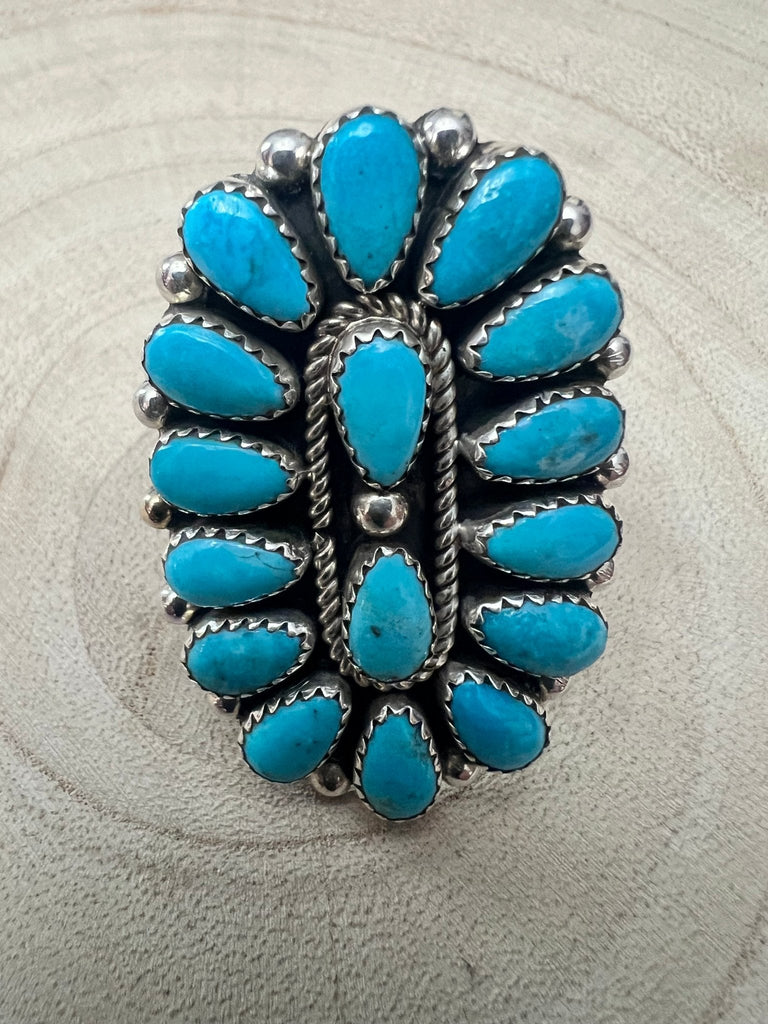
How to Tell if Turquoise Is Real: 8 Checks, Tests and Red Flags
Quick answer: To tell if turquoise is real, check the seller’s written treatment disclosure, compare the price with the claim, and inspect the stone with a 10x loupe for natural matrix, uneven color and no dye pooling. Check drill holes for white. Hot needle, acetone and scratch tests can damage stones. Only a gem lab gives a reliable answer.
Turquoise is one of the most imitated gems in the world. It’s also one of the most treated, and the line between the two confuses many buyers. A stone can be 100% turquoise yet stabilized with resin, or look convincing and contain no turquoise at all. This guide goes deeper than our Turquoise Buyer’s Guide on one question: how to tell if turquoise is real. Here’s which checks are safe, what popular “tests” prove, and when to ask a lab.
What makes real turquoise different from its look-alikes?
According to GIA, turquoise is a porous, semitranslucent to opaque hydrated copper aluminum phosphate. GIA lists these properties:
- Mohs hardness: 5 to 6
- Specific gravity: about 2.76 (range 2.40 to 2.90)
- Refractive index: 1.610 to 1.650
- Color: blue to green. Copper gives the blue, and iron shifts it toward green.
Those numbers matter because imitations differ. Howlite is much softer (about 3.5 on the Mohs scale) and naturally chalky white. Magnesite is also white and porous, and both soak up dye easily. Plastic is far lighter. The catch: stabilized turquoise is real turquoise filled with clear resin, so some “tests” that catch plastic also flag genuine stabilized stone.
What are the most common fake and treated turquoise types?
Before testing anything, know what you might be looking at. The FTC’s consumer guide to American Indian arts and crafts notes that most turquoise used today is stabilized. Here’s how each type behaves when you look closely or test it:
| Type | What it is | Look | Feel and weight | Test clues | Relative price |
|---|---|---|---|---|---|
| Natural | Turquoise, cut and polished only | Uneven, natural tones. Matrix sits in the stone, not on it. | Cool, dense, about SG 2.76 | No reaction to a hot needle. Can darken over time with skin oils. | Highest |
| Stabilized | Real turquoise impregnated with clear resin | Even color, slightly glassy polish | Similar to natural, may feel slightly lighter | Hot needle can mark or smell of resin. Acetone may affect the surface. | Moderate |
| Enhanced / Zachery-treated | Real turquoise treated to reduce porosity, sometimes improving color | Very high polish. Blue may concentrate along fractures. | Similar to natural | Matches natural on standard gem tests. GIA found it is identified mainly by chemical analysis (EDXRF). | Moderate |
| Reconstituted / block | Powder or fragments bound with resin. Often no real turquoise. | Flat, uniform color. Printed or repeating veins. | Light to medium | Hot needle melts or smells. Lab tests show resin. | Low |
| Dyed howlite or magnesite | Different white minerals dyed blue | Dye pools in cracks. White shows in drill holes. | Stone weight, cool feel | Softer than turquoise. Acetone may lift dye. Magnesite fizzes in acid (lab only). | Very low |
| Plastic, glass or ceramic | Fully man-made imitations | Too perfect. Mold seams, bubbles or fine blue dots. | Plastic feels light and warm | Plastic melts under a hot needle. Ceramic shows granular texture under magnification. | Lowest |
In a GIA study of turquoise identification by infrared spectroscopy and X-ray diffraction, most samples sold in the trade as “reconstructed turquoise” contained no turquoise at all. They were dyed, plastic-impregnated gibbsite.
How can you tell if turquoise is real at home without damaging it?
Use this checklist before you buy, or when you’re looking at a piece you already own. None of these steps harm the stone:
- Read the listing or receipt first. Look for the words natural, stabilized, enhanced, reconstituted, composite, imitation or simulated. Under the FTC Jewelry Guides, an online seller should disclose a value-affecting treatment in the product description itself. If none of those words appear, ask the seller in writing.
- Compare the price with the claim. A large “natural Sleeping Beauty” or “Number 8” stone at fashion-jewelry prices is a mismatch. Price alone doesn’t prove a fake, but it shows which claims to question.
- Study the color in daylight. Real turquoise usually shows small shifts in tone, tiny pale or darker spots, and a waxy-to-slightly-glossy polish. A flat, paint-like blue that looks identical on every bead is a warning sign.
- Trace the matrix with a loupe. Use a 10x loupe. In natural stone, matrix is part of the rock and follows its own irregular paths. Blue dye that pools along veins, or veins that look printed or repeat from stone to stone, point to dyed or reconstituted material.
- Check drill holes, chips and the back. Look inside bead holes and at any worn edges. Bright white showing under a blue surface often means dyed howlite or magnesite, because dye rarely reaches the center.
- Feel the weight and temperature. Hold the piece in your palm for a few seconds. Plastic and resin imitations often feel light and warm up quickly. Stone feels cooler and denser. This only screens out plastic.
- Look at the silver and the maker’s marks. Check for a Sterling or .925 stamp and, on artist pieces, a hallmark or signature. A hallmark doesn’t prove the stone is natural, but it lets you trace the maker.
- Get a lab report for anything valuable. If the piece is expensive, sentimental or sold as natural from a named mine, ask a gemological lab for an identification report.
If a piece passes every step, that’s encouraging, but it isn’t proof. The checklist spots problems. It can’t certify a stone as natural.
Do the hot needle, acetone and scratch tests really work?
These “tests” appear in most articles on fake turquoise, often without warnings. Each tells you something narrow, and each can damage a real stone.
Warning: Hot needle, acetone and scratch tests are destructive. They can scorch resin, dull polish, strip wax, chip stone and lower value. Only try them on a loose stone you own, or on jewelry with the seller’s explicit permission, and only on a hidden spot such as the back of a cabochon. Never test a piece you haven’t paid for without asking.
The hot needle test
What it shows: whether the surface softens, melts or smells of burning plastic. What it misses: dyed howlite and magnesite are real stones, so they pass. Stabilized turquoise contains resin, so it can mark or smell even though it’s genuine turquoise. The test can separate plastic from stone. It can’t separate real turquoise from a dyed imitation, and it can leave a permanent mark.
The acetone test
What it shows: whether dye lifts onto a cotton swab dampened with acetone (nail polish remover). Blue color on the swab strongly suggests a dyed stone. What it misses: some dyes are bonded with resin and don’t transfer, so a clean swab isn’t proof. Acetone can also attack the resin or wax used on stabilized and treated turquoise, which may leave a dull patch on a genuine stone.
The scratch test
What it shows: relative hardness. Turquoise is about 5 to 6 on the Mohs scale, while howlite is about 3.5, so a steel point marks howlite more easily. What it misses: the popular fingernail version doesn’t work, because a fingernail (about 2.5 on the Mohs scale) is softer than both howlite and turquoise. A steel knife (about 5.5) can scratch turquoise too, especially soft, chalky material. Either way, you end up with a scratched stone and an unclear answer.
The acid “fizz” test (dilute hydrochloric acid makes magnesite bubble) is clearer but riskier. It belongs in a lab.
Can a UV light tell if turquoise is real?
A UV flashlight is a non-destructive screening tool, not a verdict. Resins, glues and some dyes may glow differently from the stone around them, revealing filled cracks or coatings. But stabilized stone contains resin by design, so glow doesn’t mean fake and no glow doesn’t mean natural. Use it to find areas worth asking about.
When should you get turquoise lab tested?
Get a lab report when a piece is costly, sold as natural or by a famous mine name, or about to be resold. Gemological labs use tools such as infrared spectroscopy, Raman spectroscopy, X-ray powder diffraction and EDXRF chemical analysis. GIA research shows that this combination can identify most “turquoise” products on the market, including polymer-impregnated stone and dyed magnesite.
Some treatments can’t be detected at home at all. GIA’s study of Zachery-treated turquoise found that its gemological properties “completely overlap” those of natural turquoise. It is identified mainly by chemical analysis, which shows elevated potassium. If you’re paying a premium for “natural,” get a lab report.
What do “natural,” “genuine” and “faux” mean legally?
The FTC Guides for the Jewelry, Precious Metals, and Pewter Industries (16 CFR Part 23) set the language sellers should use:
- Treatment disclosure (§ 23.24): Sellers should disclose a treatment if it isn’t permanent, creates special care requirements, or significantly affects value. For online sales, that disclosure belongs in the product description.
- “Real,” “genuine,” “natural” (§ 23.27): These words shouldn’t describe anything manufactured or produced artificially.
- Imitations (§ 23.25): A stone name like “turquoise” shouldn’t be used for an imitation unless it’s immediately qualified with a word such as “imitation” or “simulated.” The Guides specifically say that “faux” alone is not an adequate disclosure.
- Composites (§ 23.25(d)): Gem material held together with filler or binder should be clearly qualified, along with any special care it needs.
Authenticity also covers the maker. The Indian Arts and Crafts Act of 1990 makes it illegal to market a product in a way that falsely suggests it’s Indian-made or the work of a particular tribe. An individual’s first violation can bring penalties of up to $250,000, five years in prison, or both. “Navajo-style” describes a look, not a maker. The FTC warns that qualifiers like “descent,” “heritage” and “ancestry” can signal the artist isn’t an enrolled tribal member or certified Indian artisan.
How do signatures and hallmarks help you judge a piece?
A hallmark won’t test the stone, but it gives you a maker to research. Here are real pieces from our shop. Every detail below comes from the product listing:
- Annie Chapo Signed Vintage Navajo Sterling Turquoise Ring, Size 7 ($149): Signed “Chapo” on the band, by Navajo silversmith Annie Chapo. The turquoise cabochon shows natural pyrite flecks, a good example of matrix that sits inside the stone instead of on its surface.
- Randy Billy Navajo Sterling Silver Ring with Royston Turquoise, Size 9.5 ($269): Hallmarked “Randy Billy” and “Sterling,” with a 3/4″ × 3/4″ Royston stone in mixed blue-green tones.
- Victor Coriz Navajo Concho Link Bracelet with Sleeping Beauty Turquoise ($649): Each concho is Sterling-stamped with the artist’s hallmark, and the bracelet adjusts to fit 6″ to 7½″ wrists. Its even sky blue shows that uniform color alone doesn’t mean fake.
- Kingman Turquoise with Natural Matrix Fine & Sterling Silver Multi-Use Pin ($140): A 1 × 2 inch pin by Bootleg Silver Co. with natural Kingman turquoise and distinctive matrix running through the stone.
- Heritage Series Collector Grade Ithaca Peak Turquoise Shadowbox Pendant ($575): High-grade Ithaca Peak turquoise with a natural quartz inclusion, set in hand-forged sterling shadowbox construction. About 3 inches long, by Bootleg Silver Co.
See more signed and hallmarked work in our Authentic Native Jewelry collection, or browse sterling silver rings. If a detail you care about, such as treatment, isn’t listed, ask us first.
Buyer’s tip from Leather Stone Jewels
At our Fort Worth, Texas shop, the most useful question we hear is simple: “Is this stone natural or stabilized, and can you put that in writing?” A good seller answers either way. Photograph the listing, keep your receipt and pay by credit card, as the FTC recommends, then examine the piece in daylight when it arrives. Our 7-day return window, for items in original condition, gives you time to do the non-destructive checks above. Please don’t try destructive tests on a piece you plan to return.
Key facts: how to tell if turquoise is real
- Turquoise is a hydrated copper aluminum phosphate with a Mohs hardness of 5 to 6 and a specific gravity of about 2.76 (GIA).
- The FTC says most turquoise used today is stabilized. Stabilized turquoise is real turquoise, not a fake.
- Dyed howlite and magnesite are the most common turquoise imitations. White showing in drill holes and dye pooling in cracks are the classic clues.
- A hot needle separates plastic from stone. It can’t separate real turquoise from dyed stone, and it can mark stabilized turquoise.
- The fingernail scratch test doesn’t work. A fingernail is softer than both turquoise and howlite.
- Under the FTC Jewelry Guides, “faux” alone is not an adequate disclosure for an imitation stone.
- A gemological lab report is the only reliable way to confirm that turquoise is natural.
Found out your turquoise is real but not sure if it’s treated? Read our comparison of stabilized vs natural turquoise to learn why most turquoise is stabilized, how value and care differ, and why “natural” on a label doesn’t always mean untreated.
Frequently asked questions
What is the easiest way to tell if turquoise is real?
Start with the non-destructive checks: read the seller’s treatment disclosure, compare price with the claim, look for dye pooling in the matrix with a 10x loupe, and check drill holes for white material. For a valuable piece, a gemological lab report is the only reliable answer.
Does real turquoise pass the hot needle test?
A hot needle only tells you whether the surface softens, which flags plastic or resin. Stabilized turquoise is real turquoise that contains resin, so it can also mark or smell, and the needle can scorch any stone. Only do it on a loose stone you own, or with the seller’s permission.
Will acetone remove color from real turquoise?
Acetone can lift dye from dyed howlite or magnesite, which is why people use it. It can also affect the resin or wax in stabilized or treated turquoise, so a faint color change doesn’t automatically mean the stone is fake. Test only a hidden spot, and only with permission.
Is block turquoise real turquoise?
Usually not. Block turquoise is a man-made material, often dyed plastic or resin, sometimes with stone powder mixed in. GIA researchers found that many samples sold as “reconstructed turquoise” contained no turquoise at all. It should be labeled imitation or simulated.
Can a jeweler tell if turquoise is real?
Many jewelers can spot obvious fakes with a loupe. Reliably separating natural, stabilized, enhanced and imitation turquoise takes lab tools such as infrared spectroscopy, Raman or EDXRF, so get a written lab report for high-value pieces.
Buy turquoise with the details in writing
Browse signed, hallmarked and clearly described turquoise jewelry from our Fort Worth, TX shop. Orders ship in 24–48 hours, US shipping is free on orders over $50, and returns are accepted within 7 days in original condition. Use code WELCOME10 for 10% off your first order.
Testing the stone is only half the job on Native-made pieces. To check who made the silver, see our guide to reading Navajo hallmarks, including artist initials vs metal marks, shared and forged marks, and what to get in writing.
Checking a stone sold under a famous mine name? See our comparison of Kingman and Sleeping Beauty turquoise to learn how the two differ, how often each is stabilized, and what to ask before paying a “natural Sleeping Beauty” premium.
Real turquoise is only half the question on Native pieces. The other half is who made it. Our Navajo jewelry guide covers artist hallmarks, “Navajo style” labels, sterling vs nickel silver, and the written proof to ask for before you buy.
When you are ready to buy, shop with our Authenticity Guarantee — we label materials and artist credits clearly.