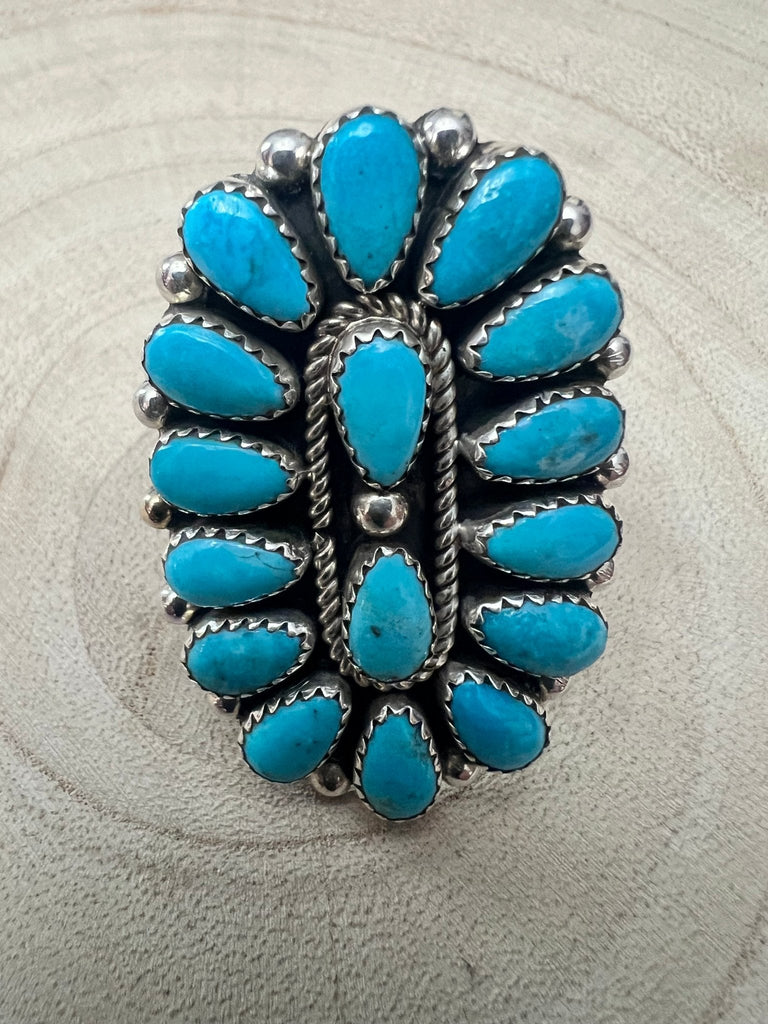
Kingman vs Sleeping Beauty Turquoise: How to Tell Them Apart
Quick answer: Kingman and Sleeping Beauty are both Arizona turquoise recovered from copper mines. Sleeping Beauty, from Globe, is known for even sky blue with little or no matrix, and its mine stopped turquoise production in 2012. Kingman, near the town of Kingman, is still produced and ranges from pale to deep blue and green, often with matrix.
If you own blue American turquoise, there’s a good chance it came from one of these two mines. The U.S. Indian Arts and Crafts Board says that “the most commonly marketed American turquoise is from the Sleeping Beauty and Kingman mines in Arizona.” They’re easy to confuse. Building on our Turquoise Buyer’s Guide, this guide compares where each comes from, how they look, how they’re treated, what drives price, and how to buy either with confidence.
Kingman vs Sleeping Beauty turquoise, defined
Kingman turquoise is turquoise from the Mineral Park mine on Ithaca Peak in the Cerbat Mountains of Mohave County, Arizona. It comes in many blues and some greens, often with matrix, and much of it is stabilized.
Sleeping Beauty turquoise is turquoise from the Sleeping Beauty Peak area of the Globe-Miami copper district in Gila County, Arizona. It’s prized for clear, even sky blue with little or no matrix. Turquoise mining there stopped in 2012.
Where do Kingman and Sleeping Beauty turquoise come from?
Neither mine was dug for turquoise. Both are large copper operations that produced so much turquoise that their names became shorthand for American blue turquoise.
Kingman: Mineral Park, Mohave County
According to the mineral database Mindat, Kingman turquoise comes from the Mineral Park mine on Ithaca Peak, in the Cerbat Mountains northwest of Kingman. Native Americans worked turquoise there before European contact. Commercial turquoise mining began in the late 1880s, and large-scale open-pit copper mining started in 1963. Since the 1970s, Colbaugh Processing (the Kingman Turquoise Mine) has recovered turquoise under lease from the copper pit. You’ll also see Kingman sold as Ithaca Peak, and its green material as Turquoise Mountain. Mindat notes it’s best known for sky blue, but the mine also yields many other blues and greens.
Sleeping Beauty: Globe-Miami district, Gila County
Sleeping Beauty turquoise comes from the Copper Cities mine area at Sleeping Beauty Peak, near Miami and Globe in Gila County. The peak is named for its outline, which looks like a woman lying asleep. Mindat records turquoise “in substantial quantities” in the mine’s leached capping and chalcocite zones. The harder material is light blue to light blue-green, and the softer material is very pale, almost white. In August 2012 the mine stopped turquoise mining to focus on copper, as Americana Indian Shows reported. Sleeping Beauty sold today comes from stone already mined.
How can you tell Kingman and Sleeping Beauty turquoise apart?
Often you can’t, at least not by eye alone. The two overlap in color more than most charts admit, but each has tendencies.
- Color: Top Sleeping Beauty is a clean, even sky or robin’s-egg blue. A GIA photo caption describes Sleeping Beauty cabochons that “have even color and show no matrix.” Kingman covers a much wider range, from pale blue to deep blue, with greens from the Turquoise Mountain side.
- Matrix: Kingman often shows matrix, from light veining to bold dark webbing. Top Sleeping Beauty shows little or none. Turquoise historians note that both mines mostly produce pale or white natural matrix, and lapidaries sometimes darken it with dye because dark matrix sells. A dramatic black web isn’t proof of either mine.
- Look-alikes: Clean, matrix-free Kingman can be nearly indistinguishable from Sleeping Beauty. Blue turquoise from other mines can look similar too.
Gem labs can tell you whether a stone is turquoise and whether it has been treated. A quick test won’t tell you which mine it came from, so mine origin rests on documentation and a seller you trust. That’s why naming the mine on the receipt matters.


How do Kingman and Sleeping Beauty turquoise compare side by side?
This table sums up how the two usually compare. These are tendencies, not rules. Any single stone can break them.
| Feature | Kingman turquoise | Sleeping Beauty turquoise |
|---|---|---|
| Where it’s from | Mineral Park mine on Ithaca Peak, Cerbat Mountains, Mohave County, northwest of Kingman, Arizona | Copper Cities mine area at Sleeping Beauty Peak, Globe-Miami district, Gila County, Arizona |
| Other trade names | Ithaca Peak, Turquoise Mountain (green material) | Usually just “Sleeping Beauty” |
| Mine status | Turquoise still recovered under lease from a working copper pit | Turquoise mining stopped in August 2012; supply is existing stock |
| Typical color | Wide range: pale sky blue to deep blue, plus greens | Even, bright sky or robin’s-egg blue at its best; lower grades pale to chalky |
| Matrix | Often present: natural white matrix, frequently darkened; dark webbing common | Little or none in top grades; any matrix is usually pale |
| Treatment | Mostly stabilized or otherwise treated; natural high-grade is a smaller share | Much was hard enough to use natural, but enhanced and stabilized material exists |
| Price position | Accessible at commercial grades; natural high-grade costs more | Usually higher grade for grade because supply is finite |
| Often chosen for | Bold cuffs, cluster work and statement pieces where matrix adds character | Inlay, needlepoint and petit point work, and small, clean cabochons |
| Can it be confused? | Clean, matrix-free Kingman can look like Sleeping Beauty | Easily imitated by Kingman, other mines’ blue stone and Imitation Turquoise |
Is Sleeping Beauty turquoise better than Kingman?
Neither is better across the board. Grade matters more than the mine name. GIA’s turquoise buyer’s guide says fine turquoise from famous mines like Sleeping Beauty “can command a small premium from collectors, but pricing is primarily based on quality, not geographic origin.” The IACB adds that higher-grade turquoise “has greater clarity and deeper color,” and that neither blue nor green is more valuable than the other.
In practice, that means:
- A hard, natural, high-grade Kingman stone can be worth more than a chalky or stabilized Sleeping Beauty stone.
- Grade for grade, natural Sleeping Beauty usually costs more because no new material is coming out of the mine.
- Natural stone from either mine is worth more than treated stone from the same mine.
Are Kingman and Sleeping Beauty turquoise usually stabilized?
Treatment is where the real difference in value lies. The IACB estimates that only about 15% of the world’s turquoise supply is natural, and that about 85% comes out of the ground too soft to cut or polish without treatment. It defines stabilized turquoise as stone “combined with colorless resins (plastics) under a vacuum or pressure to harden the stone and darken the color.” Stabilized turquoise is still real turquoise. It simply should be sold as stabilized.
Kingman: Much of Kingman’s production is stabilized or otherwise treated, so natural high-grade Kingman is the smaller, pricier share. Our buyer’s guide covers this in more detail.
Sleeping Beauty: One popular myth says Sleeping Beauty is never treated. Much of it was hard enough to work in its natural state, which is one reason inlay artists love it. But treated Sleeping Beauty exists too. In a 1999 GIA Gems & Gemology study of Zachery-treated turquoise, all the jewelry pictured in the opening figure was made from Zachery-treated Sleeping Beauty turquoise. The treated samples also included stone from Turquoise Mountain near Kingman. GIA found that this treatment overlaps natural turquoise on standard gem tests and is identified mainly by chemical analysis. If you’re paying for natural, get it in writing. Our guide on how to tell if turquoise is real explains which checks are safe and when a lab report is worth it.
Why is Sleeping Beauty turquoise getting harder to find?
Every Sleeping Beauty stone sold today was mined before 2012, and Americana Indian Shows reported that stones were getting harder to find and prices had risen significantly. Kingman rough still reaches cutters. That supply gap is the most reliable difference between the two, and the reason a “natural Sleeping Beauty” label deserves a closer look.
How do you know a Kingman or Sleeping Beauty label is honest?
Mine names are marketing claims, and the law treats them that way. Under the FTC Jewelry Guides (16 CFR Part 23):
- Origin (§ 23.1): Misrepresenting a product’s origin, treatment or quality is deceptive, so calling generic blue stone “Sleeping Beauty” crosses the line.
- Treatment (§ 23.24): Treatments that significantly affect value should be disclosed. For online sales, the disclosure belongs in the product description.
- Imitations (§ 23.25): A stone name shouldn’t be used for an imitation unless it’s clearly qualified, for example “Imitation Turquoise.” The Guides say “faux” alone isn’t enough.
The maker matters too. The Indian Arts and Crafts Act of 1990 makes it illegal to market jewelry in a way that falsely suggests it’s Indian-made or made by a particular tribe. The Act doesn’t cover the stone itself, but the IACB recommends a written receipt listing the artist and tribal affiliation, the mine, and whether the stone is natural, stabilized or treated.
Should you choose Kingman or Sleeping Beauty turquoise?
- For bold Western pieces with character: Kingman. Its matrix and range of blues suit cuffs, cluster work and statement pendants.
- For a clean, solid sky blue: Sleeping Beauty. It’s why the stone is a favorite for inlay, needlepoint and small, even cabochons.
- For everyday wear on a budget: Kingman offers the widest choice at accessible prices. Stabilized stone is durable and fine for daily wear, as long as it’s disclosed.
- For collecting: Natural, documented stone from either mine, ideally from a signed or hallmarked maker.
Which Kingman and Sleeping Beauty pieces can you see in our Fort Worth shop?
Here are real pieces currently available from our Fort Worth, Texas shop. Every detail comes from the product listing:
Sleeping Beauty turquoise
- Victor Coriz Navajo Concho Link Bracelet with Sleeping Beauty Turquoise ($649): Each concho is Sterling-stamped with the artist’s hallmark. It adjusts to fit 6″ to 7½″ wrists, and the small stones show Sleeping Beauty’s even sky blue.
- Heritage Series Sleeping Beauty Turquoise Floral Adjustable Ring ($245): A one-of-a-kind Sleeping Beauty cabochon, hand-set in fine and sterling silver by Bootleg Silver Co., with a floral and scrollwork band that adjusts to about size 10–11.
- Sleeping Beauty Turquoise Teardrop Earrings, Sterling Silver ($80): 2¼″ teardrops by The Bijoux FAB, made in the USA, with Sleeping Beauty turquoise, 3 mm and 4 mm sterling silver saucer beads, and sterling findings.
Kingman turquoise
- Anthony Brown Navajo Sterling Silver Bracelet with Kingman Turquoise ($899): Hallmarked “Anthony B” and Sterling. It’s 3/4″ wide and 5⅜″ long with a 1¼″ gap, for about a 6⅝″ wrist.
- Jimson Belin Navajo Sterling Silver Necklace with Kingman Turquoise ($289): A 1⅛″ × 1⅝″ pendant on a 16″ chain, hallmarked .925.
- Debbie Livingston Navajo Kingman Turquoise Sterling Silver Ring ($124): Kingman turquoise set in sterling silver with traditional silverwork details, in sizes 7, 8 and 8.5.
These listings name the mine and the maker but don’t state whether the stone is natural or stabilized, so ask us before you buy. Browse more signed work in our Authentic Native Jewelry collection or our sterling silver bracelets.
Buyer’s tip from Leather Stone Jewels
At our Fort Worth shop, we suggest asking two questions together: “Which mine is this from?” and “Is it natural or stabilized?” The answer to the second matters more for value. A perfectly even sky-blue stone is the classic Sleeping Beauty look, and also the easiest look to copy. Get the mine, treatment and maker on your receipt. When the piece arrives, use our 7-day return window, for items in original condition, to look it over in daylight.
Key facts: Kingman vs Sleeping Beauty turquoise
- Kingman and Sleeping Beauty are the most commonly marketed American turquoise (IACB).
- Kingman turquoise comes from the Mineral Park mine on Ithaca Peak, Mohave County, Arizona.
- Sleeping Beauty turquoise comes from the Globe-Miami copper district in Gila County, Arizona. Turquoise mining there stopped in August 2012.
- Top Sleeping Beauty is even sky blue with little or no matrix. Kingman ranges from pale to deep blue and green and often shows matrix.
- Clean Kingman can look like Sleeping Beauty, so color alone can’t prove which mine a stone came from.
- Both mines’ turquoise is sold natural and treated. GIA has documented Zachery-treated Sleeping Beauty.
- GIA says turquoise pricing is based mainly on quality, not origin. A famous mine adds only a small collector premium.
- Under 16 CFR Part 23, misrepresenting a gem’s origin or failing to disclose a value-affecting treatment is deceptive.
Frequently asked questions
Which is more expensive, Kingman or Sleeping Beauty turquoise?
Grade for grade, natural Sleeping Beauty usually costs more because its mine stopped turquoise production in 2012 and supply is limited to existing stock. GIA notes that famous mines can carry a small collector premium, but quality drives price. High-grade natural Kingman can cost more than low-grade or stabilized Sleeping Beauty.
Can you tell Kingman from Sleeping Beauty turquoise just by looking?
Not reliably. Sleeping Beauty is known for even sky blue with little or no matrix, but clean, matrix-free Kingman can look almost the same. Dark matrix and green tones point toward Kingman, yet matrix can be dyed. Mine origin is best supported by documentation from a seller you trust.
Is Sleeping Beauty turquoise still being mined?
No. The Sleeping Beauty mine near Globe, Arizona, stopped turquoise mining in August 2012 to focus on copper. Sleeping Beauty turquoise sold today comes from stone that was already mined, which is why good material keeps getting harder to find.
Is Kingman turquoise real turquoise?
Yes. Kingman turquoise is genuine turquoise from the Mineral Park mine near Kingman, Arizona. Much of it is stabilized with resin to harden it and deepen its color, which is still real turquoise but should be disclosed. Only stone sold as natural should be untreated.
Is Sleeping Beauty turquoise ever stabilized or treated?
Yes. Much Sleeping Beauty was hard enough to cut naturally, but treated Sleeping Beauty exists too. A 1999 GIA study examined jewelry made from Zachery-treated Sleeping Beauty turquoise. If you are paying for natural stone, ask for that in writing.
Find your blue: Kingman or Sleeping Beauty
Compare signed Navajo and handmade turquoise jewelry from our Fort Worth, TX shop, and ask us anything about a stone before you buy. Orders ship in 24–48 hours, US shipping is free on orders over $50, and returns are accepted within 7 days in original condition. Use code WELCOME10 for 10% off your first order.