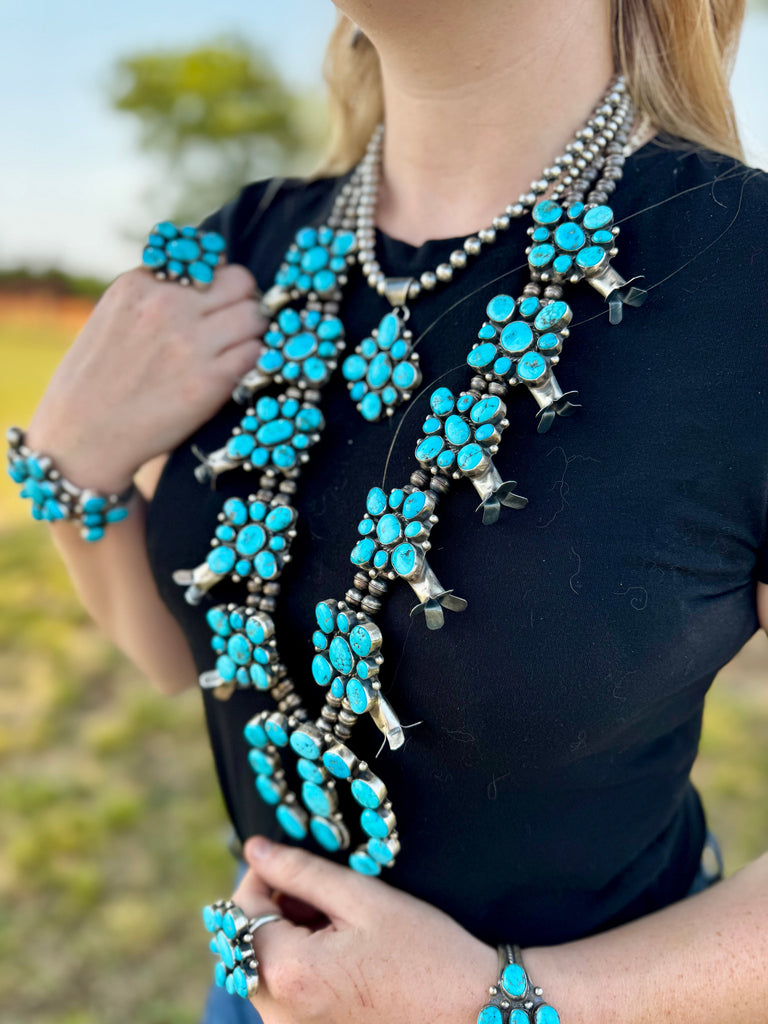
Squash Blossom Necklace Meaning: Naja, Blossoms and History
Quick answer: A squash blossom necklace is a Navajo (Diné) silver necklace with flared “blossom” beads and a crescent pendant called the naja. There’s no single official meaning. Historically it signaled wealth and status. Today Diné wearers link it to fertility, balance and the journey of life. The English name is an outsider’s label.
The squash blossom is New Mexico’s official state necklace, Navajo regalia and one of the most copied designs in western jewelry. Much of what’s repeated about its meaning online is guesswork, so this guide separates what museums and Diné voices actually say from theory. For the wider story of Navajo silverwork, see our Navajo jewelry guide.

What does a squash blossom necklace mean?
There is no single meaning, and Diné writers are careful to say so. In an essay for the RISD Museum, Diné curator Sháńdíín Brown, from a family of jewelry makers, notes that individual Diné hold different beliefs about the form. She shares the meanings she learned from her family:
- Femininity and fertility. Squash is a traditional Diné food, and the beads recall how male and female squash flowers pollinate, a balance that matters in a matriarchal culture.
- The journey of life. In one reading, the top bead on the wearer’s right is the start of life, each bead after it is a stage of life, and the last bead on the left is the end of the journey.
- Birth and protection. For some Diné, the naja represents the womb or umbilical cord, which is why it rests near the navel. Others see it as the bow of Monster Slayer, one of the Hero Twins who rid the world of monsters.
- Balance and beauty. The necklace is strictly symmetrical, which Brown ties to hózhó, a core Diné idea that roughly means balance, beauty and harmony.
Older meanings were more practical. The Maxwell Museum of Anthropology at the University of New Mexico says squash blossom necklaces, like silver horse bridles, were signs of wealth and status. The New Mexico Secretary of State notes the necklace is worn by both men and women.
What are the parts of a squash blossom necklace?
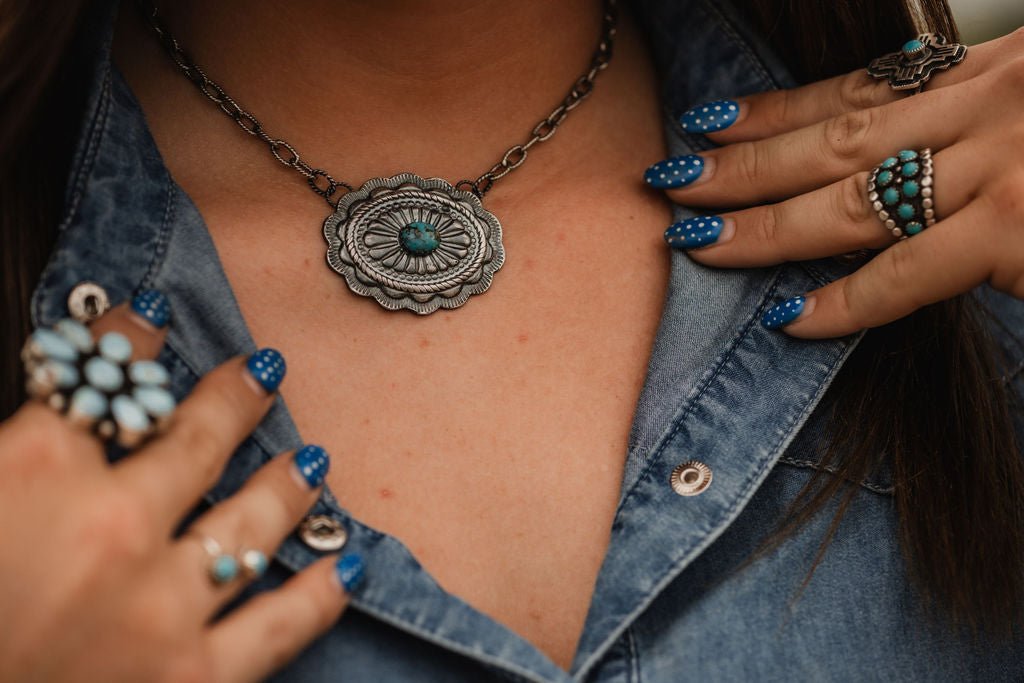
A classic squash blossom has three elements strung in a symmetrical line: round silver beads, flared blossom beads in matching pairs up both sides, and the naja hanging at the lowest point. Turquoise is common but not required. The earliest necklaces were all silver.
| Part | Diné name (as published) | Likely source of the form | Meanings people attach to it |
|---|---|---|---|
| Naja (crescent pendant) | Názhah, “crescent shape” | Moorish crescent carried to Spain, then to the Southwest on Spanish and Mexican horse bridles; possibly also via Plains tribes | Protection from the evil eye (Spanish use); for some Diné, the womb or umbilical cord, or Monster Slayer’s bow |
| Blossom beads | Yoo’ nímazí disya gi, “bead which spreads out” | Spanish-Mexican pomegranate-shaped buttons and clothing ornaments; also compared to squash flowers | Flowering, fruitful plants; fertility and the balance of female and male; for some, stages of life |
| Round beads (“Navajo pearls”) | Not separately named in our sources | Domed halves of hammered coin or sheet silver soldered together | Part of the necklace’s show of wealth and status |
| Turquoise settings | Not separately named in our sources | Added later; museums date stone-set necklaces to after about 1880, with Zuni influence on stone-set blossoms | A core Diné material; elder Wally Brown, quoted by RISD, links it to origin and prayer |
Diné spellings are as printed by the RISD Museum; other sources spell them differently.
Why is it called a “squash blossom” necklace?
Because an outsider called it that, and the name stuck. The Diné word for the flared bead, as the RISD Museum gives it, translates to “bead which spreads out.” Nothing in it mentions squash or any other flower. The Smithsonian American Art Museum puts it bluntly: the origin of the name is uncertain, “because the beads do not actually look like squash blossoms.”
Anthropologist John Adair, who studied Navajo and Pueblo silversmiths in the 1930s and 1940s, offered the best-known explanation. As summarized by Americana Indian Shows, Adair thought a non-Native person probably asked a Navajo smith what the bead represented, was told it looked like a squash blossom, and took that as its meaning.
That doesn’t make the squash reading wrong: some Diné families, as Brown describes, connect the beads to squash flowers. But the English name came from outside.
Where did the naja come from?
The crescent is far older than Navajo silversmithing. The Spencer Museum of Art says the design was brought to Spain by the Islamic Moors, possibly as early as the 8th century. The Spanish carried it to the Southwest on horse bridles, where it was believed to be protective. The Smithsonian’s National Postal Museum describes it as an amulet on Spanish colonial horse headbands “said to ward off the evil eye.”
Diné smiths saw these crescents on Spanish, Mexican and Plains tribes’ bridles and adopted the shape. According to the University of Arizona’s Ancient to Modern exhibit, Diné smiths began making silver-bead necklaces with naja pendants around 1880. Early najas were often cast in carved tufa stone molds.
Does a naja still mean protection? The Gilcrease Museum, citing Durbin (1999), says the Navajo respect the symbol but claim it has no spiritual significance. So the evil-eye story belongs to the Spanish history of the shape, not to a documented Navajo belief.

Are the blossoms really pomegranates?
Probably, at least in origin. The Smithsonian Postal Museum says the bead is “based on a stylized version of the pomegranate blossom.” The usual source is Spanish-Mexican silver trouser and jacket ornaments shaped like pomegranates, a connection Arthur Woodard drew in 1938. The Maxwell Museum notes the pomegranate appeared on Spanish soldiers’ uniform buttons.
The Americana article adds a fair caution: there is real doubt that Navajo smiths meant to depict a pomegranate, or any blossom at all. Here’s how to judge the claims you’ll see on jewelry sites:
| Claim you’ll read online | What the sources actually say | Confidence |
|---|---|---|
| The naja comes from Moorish North Africa | Museums describe Spanish-Moorish roots via bridle ornaments; a Plains route is also possible | Widely held by scholars |
| The blossoms are really pomegranates | Traced to Spanish-Mexican pomegranate ornaments; some doubt smiths meant any flower | Probable, not proven |
| The name “squash blossom” is Navajo | The Diné word means “bead that spreads out”; the English name came from outsiders | Name is not Navajo |
| The necklace is an ancient Navajo tradition | Most sources date it to about 1880 | Late 1800s design |
| The naja is a sacred religious symbol | Navajo respect it but claim no spiritual significance (Gilcrease); personal meanings vary | Meaning varies by person |
When were squash blossom necklaces first made?
Most sources place the first squash blossoms in the late 1800s, around 1880, a few decades after Navajo smiths learned silversmithing from Mexican plateros in the mid-1800s. Brown notes that when Diné silversmiths began making them, the design “was not traditional, but new.” Dates vary: an Antiques Roadshow appraiser said the 1860s, while Adair dated them after 1880.
Early necklaces were made from melted American and Mexican silver coins. Later, traders supplied sheet silver. Necklaces from the “First Phase” of Diné jewelry (1868–1900) rarely had set stones; Adair called stone-set blossoms a Zuni influence.
The Maxwell Museum notes the form spread quickly to other tribes and pueblos. Popularity soared in the 1970s, and in 2011 New Mexico adopted the squash blossom as its official state necklace.
Can anyone wear a squash blossom necklace?
Yes. Navajo smiths have sold squash blossoms to outside buyers since the trading-post era, and men and women wear them. For many Diné it’s also regalia and an heirloom; Brown inherited her grandmother’s. Wearing one respectfully comes down to how you buy it: choose Native-made work from honest sellers and learn the artist’s name. An honestly labeled “Southwestern-style” piece is fine. A fake labeled “Navajo” isn’t.
How do you check that a squash blossom necklace is authentic?
Check these five things before you buy:
- Ask who made it. Get the silversmith’s name and tribal affiliation in writing on the listing or receipt. The Indian Arts and Crafts Board recommends this for any purchase described as Native-made.
- Look for a hallmark. Check the back of the naja and the clasp area for a maker’s mark and a STERLING or .925 stamp. Many older necklaces are unsigned, so a missing mark isn’t proof of a fake, but it means you need other documentation.
- Examine the beads. Handmade beads are made from two domed halves soldered together, and blossoms are built from separate petals. Look for slight variation from bead to bead, solid weight and clean solder joins.
- Check the stones. Ask whether the turquoise is natural, stabilized or reconstituted, and what mine it came from if known. Treatment affects price, not whether the piece is Native-made.
- Read the wording. “Navajo-style,” “Southwestern” or “inspired” describes a look, not a maker. Under the Indian Arts and Crafts Act, a piece sold as “Navajo” must be made by a member of the Navajo Nation.
The law backs you up. The Indian Arts and Crafts Act of 1990 makes it illegal to sell any art or craft in a way that falsely suggests it is Indian-made or the product of a particular tribe. The FTC and IACB brochure uses this exact example: selling jewelry as “Navajo Jewelry” when it wasn’t made by members of the Navajo Nation. The IACB’s consumer tips recommend getting a receipt that lists the maker and their tribal affiliation. To read the marks themselves, see our guide to Navajo hallmarks. To check the stones, see how to tell if turquoise is real and stabilized vs natural turquoise.
Buyer’s tip from Leather Stone Jewels
Ask for a squash blossom’s weight and length before you buy; full handmade necklaces can be heavy. A naja pendant or blossom earrings carry the same history in a lighter, everyday piece. Our listings say whether a piece is Native-made, who made it when we know, and whether it’s sterling or silver-plated.
Which squash blossom and naja pieces can you see in our shop?
These pieces are available now at Leather Stone Jewels, a western turquoise, leather and silver jewelry shop in Fort Worth, Texas. Details come from each listing:
- Complete Squash Blossom Set by Navajo silversmith Wilson Dawes ($12,000): Eight pieces stamped sterling with genuine Kingman turquoise: a squash blossom necklace on handmade silver beads, stud earrings, two adjustable rings, two cuffs, a pendant and a brooch.
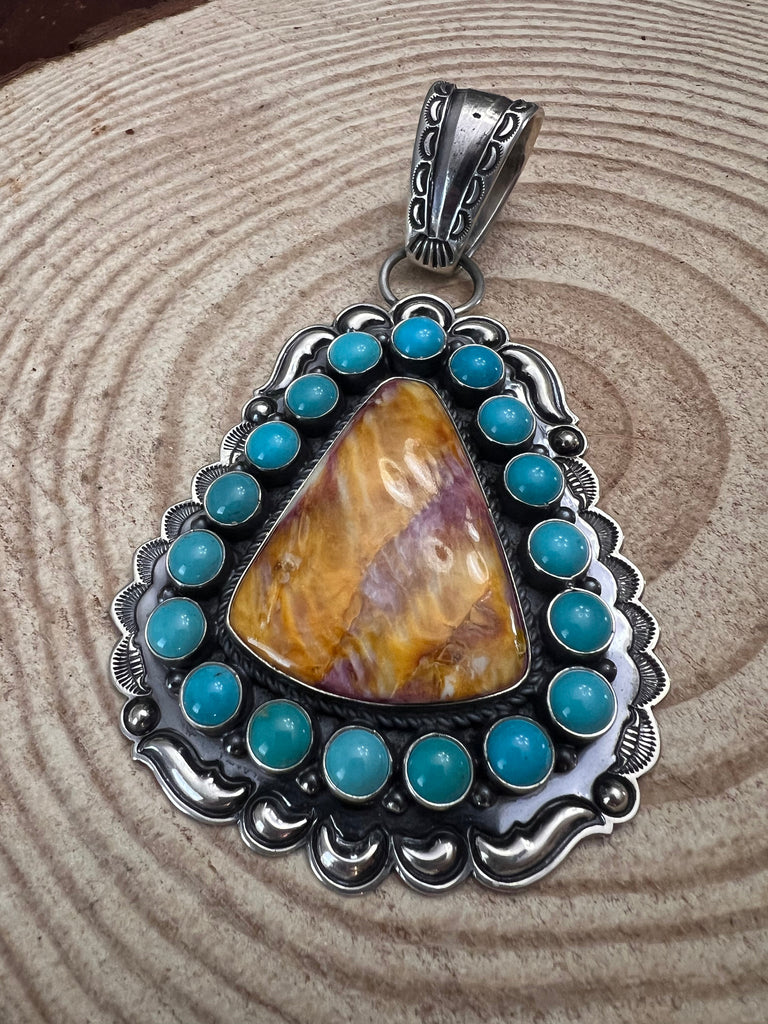
- Vintage Native American Sandcast Sterling Silver Naja Pendant with Turquoise ($499): A one-of-a-kind vintage sandcast naja with a turquoise center. Its bail is made to slide onto a Navajo pearl necklace. The listing doesn’t name the maker.
- Crystal Hayley Navajo Barrel and Squash Blossom Dangle Earrings ($120): Sterling silver, handcrafted by Navajo artist Crystal Hayley, 1 3/4″ drop.
- Jimson Belin Navajo Sterling Silver Necklace with Kingman Turquoise ($289): By Navajo silversmith Jimson Belin, hallmark .925, on a 16″ chain with a 1 1/8″ × 1 5/8″ pendant.
- Sterling Silver Squash Blossom Statement Earrings ($99): A Western-style sterling squash blossom on sterling wires, 21 mm drop × 13 mm wide. The listing doesn’t name a maker or claim Native origin.
- Kingman Turquoise Naja Pendant with 5-Stone Top ($106): A Native American-inspired, silver-plated naja with Kingman turquoise in serrated bezels. Sold under our Leather Stone Jewels label; not Native-made.

Our listings don’t state gram weights or whether each stone is natural or stabilized; ask us. Browse more in our Authentic Native Jewelry collection and our sterling silver necklaces. To keep silver and turquoise looking right, read how to clean turquoise jewelry. To compare Navajo work with its neighbors, see Navajo vs Zuni vs Hopi jewelry.
Key facts: squash blossom necklace meaning
- A squash blossom necklace combines round silver beads, flared “blossom” beads and a crescent pendant called the naja.
- Diné (Navajo) smiths first combined the blossom beads and naja into a necklace, around 1880 by most accounts.
- The Diné word for the blossom bead means “bead that spreads out.” “Squash blossom” is an English label from outsiders.
- The naja’s crescent traces to Moorish Spain and Spanish bridle ornaments said to ward off the evil eye.
- The blossom bead probably derives from Spanish-Mexican pomegranate ornaments.
- Meanings vary: wealth and status historically; for some Diné today, fertility, balance (hózhó) and the journey of life.
- Under the Indian Arts and Crafts Act, only a piece made by a Navajo Nation member can be sold as “Navajo.”
Styling a squash blossom? Let it be the only big piece in the outfit. Our western jewelry style guide shows which necklines and earrings work with statement necklaces.
Frequently asked questions
What does the naja symbolize on a squash blossom necklace?
The crescent came to the Navajo via Spanish and Mexican horse bridles, where it was an amulet against the evil eye. Navajo smiths adopted the shape without one fixed meaning. Some Diné today see it as the womb, the umbilical cord or Monster Slayer’s bow.
Is it okay for non-Native people to wear a squash blossom necklace?
Yes. Navajo smiths have made squash blossoms for outside buyers since the trading-post era. Wear one respectfully by buying from Native artists or honest dealers, learning the maker’s name and avoiding pieces falsely sold as Native-made.
Why is it called a squash blossom necklace?
The English name is an outsider’s label. The Diné word for the flared bead translates to “bead that spreads out,” with no mention of squash. Anthropologist John Adair suggested the name came from a non-Native person who took a Navajo smith’s comment that the bead looked like a squash blossom as its meaning.
Are squash blossom necklaces only made by the Navajo?
No. The Navajo were the first to combine the blossom beads and naja into a necklace, but the form spread quickly to Zuni and other Pueblo artists. The Maxwell Museum holds one made around 1942 by A:shiwi (Zuni) artist Josephine Buqua.
How much is a squash blossom necklace worth?
It depends on the maker, age, silver weight, stones, condition and documentation. On PBS’s Antiques Roadshow, a coin-silver Navajo squash blossom from about 1910 was appraised at $7,000–$9,000 at auction in a 2023 update. Imitations can cost under $30; signed contemporary sets can reach five figures.
Squash blossoms and najas, honestly labeled
Shop Navajo-made squash blossom pieces and naja pendants from Leather Stone Jewels in Fort Worth, TX, with the maker named where we know it. Orders ship in 24–48 hours, US shipping is free on orders over $50, and returns are accepted within 7 days in original condition. Use code WELCOME10 for 10% off your first order.
Looking for squash blossom necklaces for sale, or wholesale for your boutique? See our squash blossom collection and wholesale pricing.