Navajo Jewelry Guide: History, Styles and How to Buy Authentic
Quick answer: Navajo jewelry is handmade silver jewelry, often set with turquoise, made by Diné (Navajo) artists. It’s known for heavy sterling, hand stamping and cast silver. Navajo silversmithing began around the 1850s to 1870s. Under federal law, only Navajo Nation members or certified Navajo artisans can sell jewelry as “Navajo.”
Navajo silver is the jewelry most people picture when they think of the American Southwest: squash blossom necklaces, concho belts and heavy turquoise cuffs. It’s also widely imitated. This guide covers its history, techniques and classic pieces, how it differs from Zuni and Hopi work, and how to buy the real thing. For the stones themselves, see our Turquoise Buyer’s Guide.

What is Navajo jewelry?
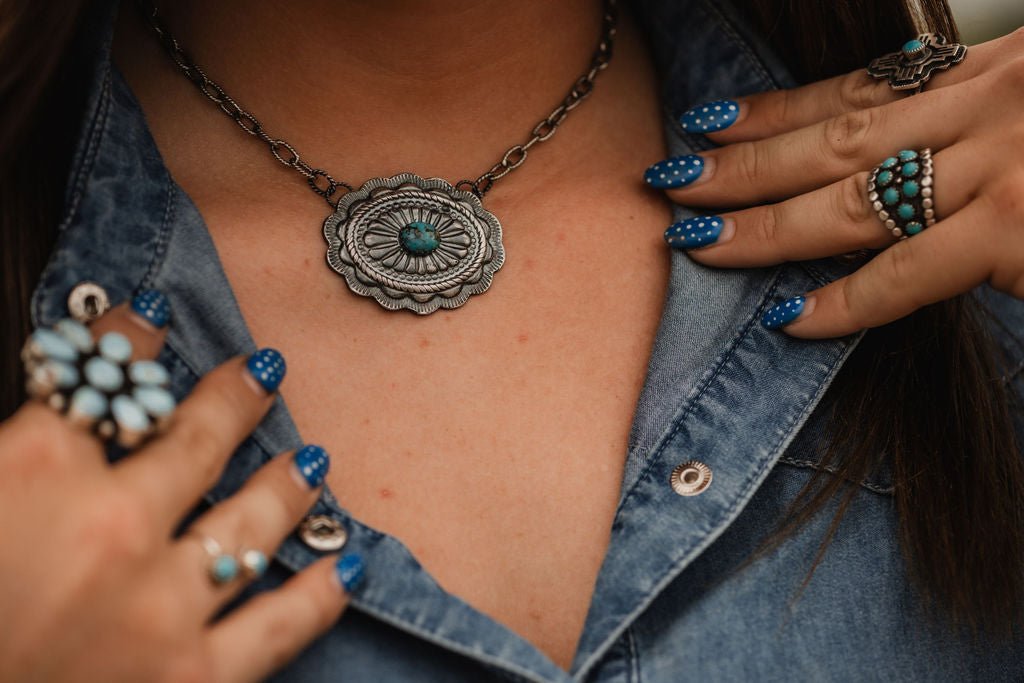
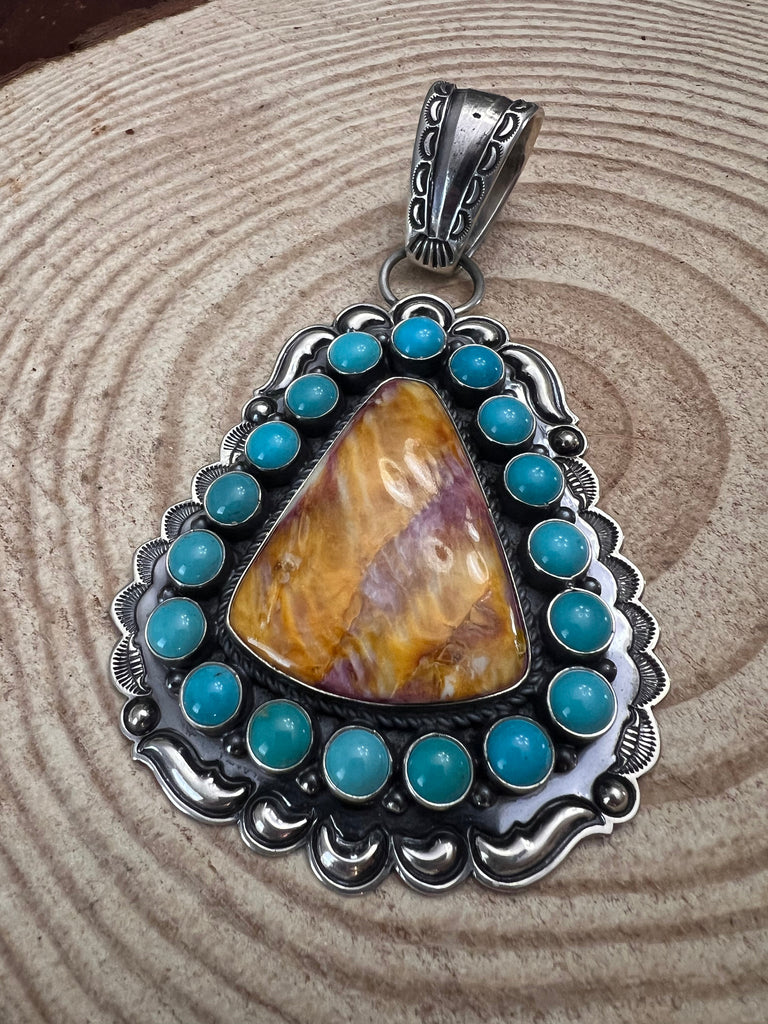
Navajo jewelry is made by members of the Navajo Nation, who call themselves Diné. The Arizona State Museum describes traditional Navajo work as “characterized by large settings of turquoise, elaborate stampwork, and use of the sandcasting technique.” Most pieces are sterling silver, and many contemporary Navajo artists also use coral, spiny oyster, opal and other stones.
“Navajo” describes who made a piece, not just how it looks.
When did the Navajo start making silver jewelry?
The Heard Museum notes that the governor of New Mexico recorded Navajo people wearing silver as early as 1795, but Navajo smiths learned to make it in the mid-1800s:
- Blacksmithing first. Navajo men learned ironwork from Mexican blacksmiths in the 1830s. In 1853 a Navajo headman named Herrero, later called Atsidi Sani (“Old Smith”), watched a Mexican silversmith at the new Navajo agency at Washington Pass. He is credited as the first Navajo silversmith.
- Bosque Redondo (1864–1868). During the forced confinement at Bosque Redondo (Fort Sumner), military reports recorded Navajo iron and silver working, including silver buttons strung into necklaces.
- A disputed start date. Navajo elders told anthropologist John Adair that Atsidi Sani didn’t work silver until after the 1868 return home. Other evidence points earlier. Adair concluded the craft began “as early as 1850 or as late as 1870.”
- Coin silver. Silver was never mined by Native people of the Southwest. Smiths melted Mexican pesos, imported by traders in the 1870s, and later US coins. Once defacing currency was outlawed in both countries, traders supplied 1-ounce silver squares from a California refinery.
- Stones arrive. Setting turquoise in silver began in the 1880s and was widespread by the 1890s.
- Traders and a 1970s boom. Traders promoted Navajo silver after 1868, and the Arizona State Museum notes that Native jewelry saw “an enormous boom in popularity” in the 1970s.
What techniques do Navajo silversmiths use?
Early Navajo smiths made stamps from iron tools such as nails and files, and the Heard Museum says stamping became “the primary method of decorating silver.” Casting came from Mexican silversmiths, first in sand, later in reusable carved tufa molds. The table compares Navajo techniques with Zuni and Hopi ones they’re often confused with.
| Technique | How it’s done | What to look for | Most associated with |
|---|---|---|---|
| Hand stamping | Steel stamps are struck into silver with a hammer, one impression at a time | Crisp but slightly varied impressions; the FTC says stamped images should be clear, not blurred | Navajo (the main decoration method since the 1800s) |
| Repoussé | Silver is pushed up from the back to raise a domed or fluted design | Raised ridges and bumps, often with stamping around them; common on conchos and ketohs | Navajo |
| Sand casting | Molten silver is poured into a mold carved into packed sand. Each mold is used once. | Slightly grainy, organic surface; bold, sculptural shapes | Navajo (learned from Mexican silversmiths) |
| Tufa casting | The same idea, using a mold carved into soft volcanic tufa stone, which can be reused | Fine, swirling stone texture left on the silver | Navajo |
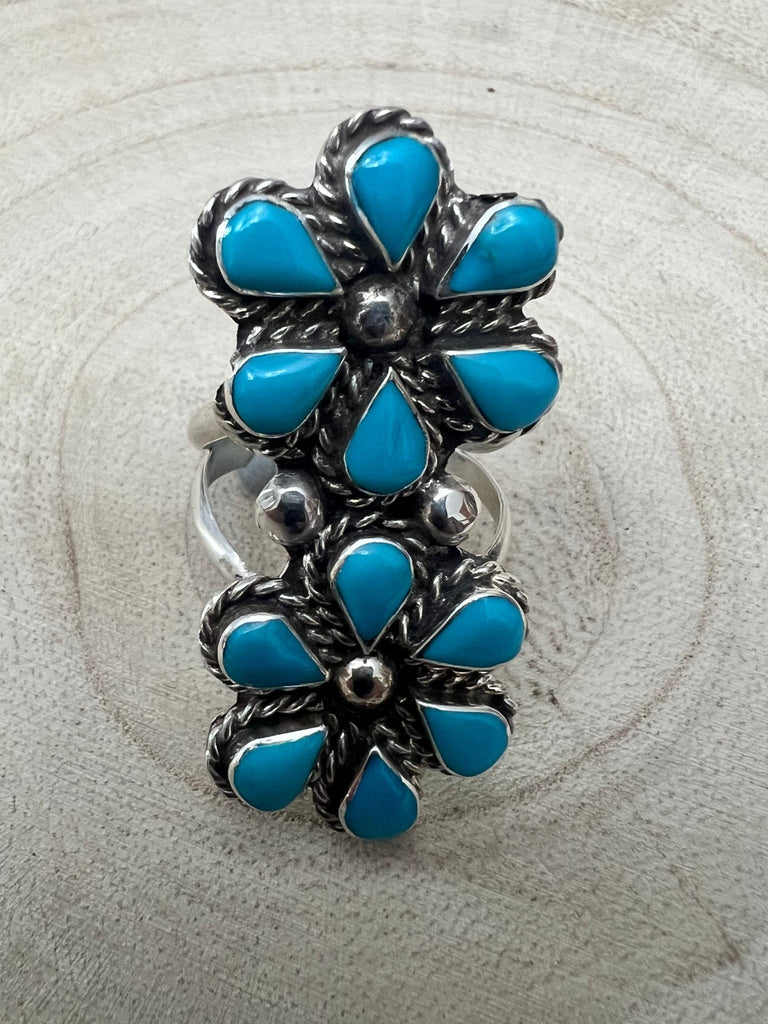
| Cluster work | Many stones of similar size set in individual bezels around a center | Rows or rings of matching stones | Zuni, adopted by Navajo smiths in the 1940s |
| Needlepoint and petit point | Tiny stones cut into slender points (needlepoint) or small rounds and ovals (petit point) | Dozens of precisely matched small stones | Zuni |
| Inlay | Cut stones fitted edge to edge into silver channels or a flat surface | Tight seams between stones, smooth surface | Zuni (also many Navajo artists) |
| Overlay | A cut-out silver sheet is soldered onto a textured, darkened silver backing | Bright raised design over a dark recessed layer | Hopi (developed in the late 1930s and 1940s) |
Needlepoint is a Zuni specialty. Navajo smiths adopted Zuni-style cluster work in the 1940s, often with stones cut by Zuni lapidaries, so a cluster piece can be Navajo- or Zuni-made. Only the maker can tell you which.


How is Navajo jewelry different from Zuni and Hopi jewelry?
The three are the best-known Southwestern silver traditions. Alltribes puts it simply: Navajo artists start with the stone and build the silver around it, while Zuni artists build the frame and fill it with precisely cut stones. Hopi overlay, developed with the Museum of Northern Arizona in the late 1930s according to the Arizona State Museum, makes the silver design itself the focus.
| Navajo (Diné) | Zuni (A:shiwi) | Hopi | |
|---|---|---|---|
| Focus | Heavy silverwork | Stone cutting and setting | Silver design |
| Typical stones | One or a few large stones, often turquoise | Many small, precisely cut stones | Few or none |
| Signature techniques | Stamping, repoussé, sand and tufa casting, twisted wire | Needlepoint, petit point, cluster, inlay | Overlay |
| Classic pieces | Squash blossoms, concho belts, stamped cuffs, ketohs | Needlepoint and cluster bracelets, inlay pendants | Overlay cuffs, buckles, pendants |
These are tendencies, not rules. Many artists work across styles.
What are the classic Navajo jewelry pieces?
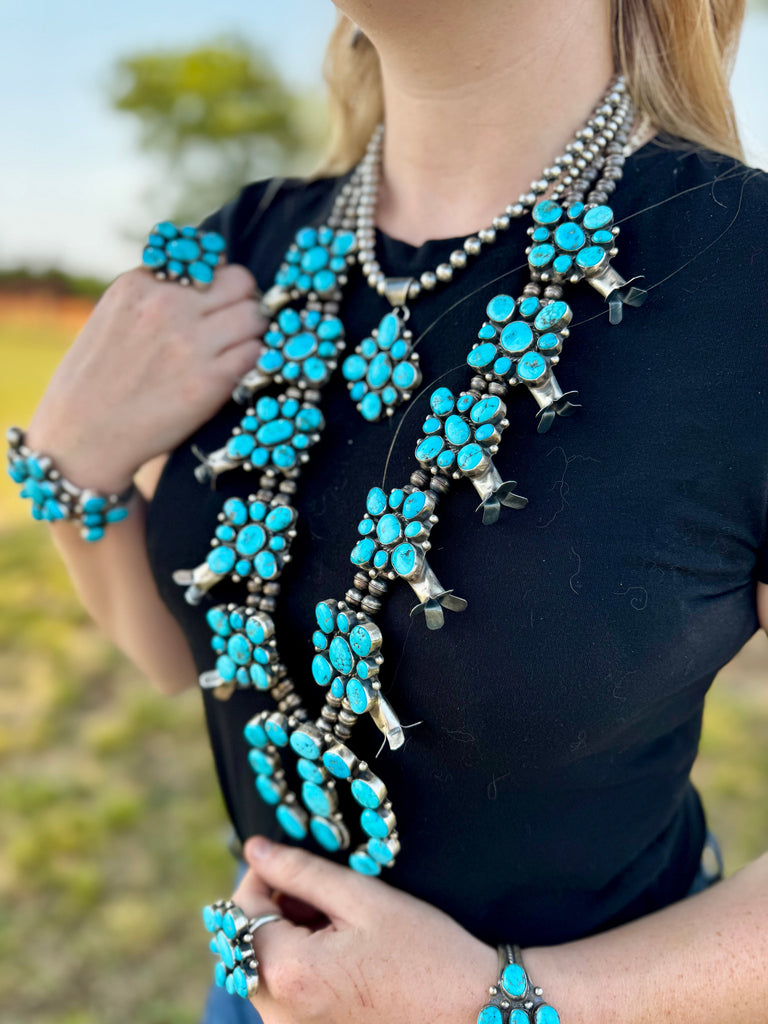
- Squash blossom necklace: Silver beads, flared “blossom” beads and a crescent pendant called a naja. The Heard Museum says the Navajo word for the blossoms translates to “bead that flares out.” The naja came from a Spanish bridle ornament with Moorish roots and appeared on necklaces around 1880. Many stories claim a spiritual meaning, but the Heard calls the naja “simply an article of jewelry.”
- Concho belt: Round or oval silver plates on a leather belt. Navajo conchos were influenced by scalloped Spanish Colonial buckles, and early ones had diamond-shaped open centers for the belt to pass through.
- Cuff bracelet: From stamped bands to cast cuffs and rows of set stones.
- Ketoh (bow guard): A silver plate on a leather wristband, from the guards archers wore. Later ketohs became showpieces of stamping, repoussé and sand casting.
- Bolo tie: A cord tie with a decorative slide, often silver and turquoise. The “bola tie” is Arizona’s official state neckwear.
What role does turquoise play in Navajo jewelry?
Turquoise is the signature stone, often from named mines such as Kingman, Sleeping Beauty and Royston (see Kingman vs Sleeping Beauty turquoise). Much of it is treated. The FTC and IACB consumer brochure says “the majority of turquoise used today is stabilized,” and that natural gem-quality turquoise is usually used by top artists and costs more. Read our guide to stabilized vs natural turquoise, and check the stone itself with how to tell if turquoise is real. A Navajo-made piece can still use stabilized stone, so ask about both.
How can you tell if Navajo jewelry is authentic?
No single test proves it. Combine these checks:
- Ask who made it. A reputable seller can name the artist and their tribe. “Native American style” or “Southwest style” with no maker named is a red flag.
- Read the marks correctly. An artist’s hallmark (initials, a name or a symbol) is usually inside a cuff or ring or on the back of a pendant. “STERLING” or “.925” only describes the metal: under the FTC Jewelry Guides, “sterling” means at least 925/1,000 silver.
- Don’t rule out unsigned pieces, or trust signed ones blindly. A hallmark field guide notes that pre-1940 work is mostly unsigned and that marks can be forged.
- Look at the workmanship. The FTC brochure says well-made pieces have no wavering lines or lopsided designs, stamped images should be clear, and stones should fit snugly. Lots of metal-colored glue around a stone is a warning sign.
- Know the metals. Nickel silver (60% copper, 20% zinc, 20% nickel) contains no silver. The FTC says it shouldn’t be called silver at all. Silver-plated pieces can’t be stamped “sterling.”
- Get it in writing. The Indian Arts and Crafts Board recommends a receipt listing the price, maker and maker’s tribal affiliation, and a written guarantee of authenticity.
What does the Indian Arts and Crafts Act protect?
The Indian Arts and Crafts Act of 1990 (P.L. 101-644) is a truth-in-advertising law. It is illegal to sell any art or craft in a way that falsely suggests it is Indian-made or the product of a particular tribe. The FTC brochure gives this exact example: marketing jewelry as “Navajo Jewelry” when it wasn’t made by members of the Navajo Nation violates the law. It covers items made after 1935. Words like “descent,” “heritage” or “ancestry” don’t mean the maker is a tribal member.
Penalties are serious. For a first violation, an individual faces up to a $250,000 fine, five years in prison, or both. A business can be fined up to $1,000,000. Report suspected fakes to the Indian Arts and Crafts Board at 1-888-ART-FAKE.
How much does Navajo jewelry cost?
Price depends on the artist, the amount of silver, the technique, the stone and its treatment, age and condition. The IACB says authentic handmade pieces may be expensive, and if a price seems too good to be true, ask more questions.
For a sense of range, signed Navajo pieces in our shop currently run from $67 for hallmarked drop earrings to $12,000 for a complete eight-piece squash blossom set.
Thinking of starting a collection? Read our guide to collecting signed Navajo jewelry to learn what a signature proves, whether signed pieces are worth more and what to get in writing.
Buyer’s tip from Leather Stone Jewels
Before you buy any Navajo piece, ask the seller three questions: who made it, what tribe are they from, and is the stone natural or stabilized? Then make sure the listing or receipt says the same. We name the silversmith and hallmark in our listings. If a detail isn’t listed, ask us before you order.
How do you care for Navajo silver and turquoise?
Wipe pieces with a soft dry cloth, polish only the silver with a polishing cloth, and never use silver dips, ultrasonic or steam cleaners on stone-set pieces. Leave darkened recesses alone, since that oxidation makes stamp work stand out. See our guide on how to clean turquoise jewelry.
Which signed Navajo pieces can you buy from our Fort Worth shop?
Available now from our Fort Worth, Texas shop, with details from each listing:
- Complete Squash Blossom Set by Wilson Dawes ($12,000): Eight pieces handmade by Navajo silversmith Wilson Dawes, stamped sterling, with genuine Kingman turquoise: a squash blossom necklace, stud earrings, two adjustable rings, two cuffs, a pendant and a brooch.
- Anthony Brown Navajo Sterling Silver Bracelet with Kingman Turquoise ($899): Hallmarked “Anthony B” and Sterling. 3/4″ wide, 5 3/8″ long with a 1 1/4″ gap, for about a 6 5/8″ wrist.
- Victor Coriz Navajo Concho Link Bracelet with Sleeping Beauty Turquoise ($649): Sterling silver conchos, each stamped Sterling with the artist’s hallmark. Adjustable to fit 6″ to 7 1/2″ wrists.
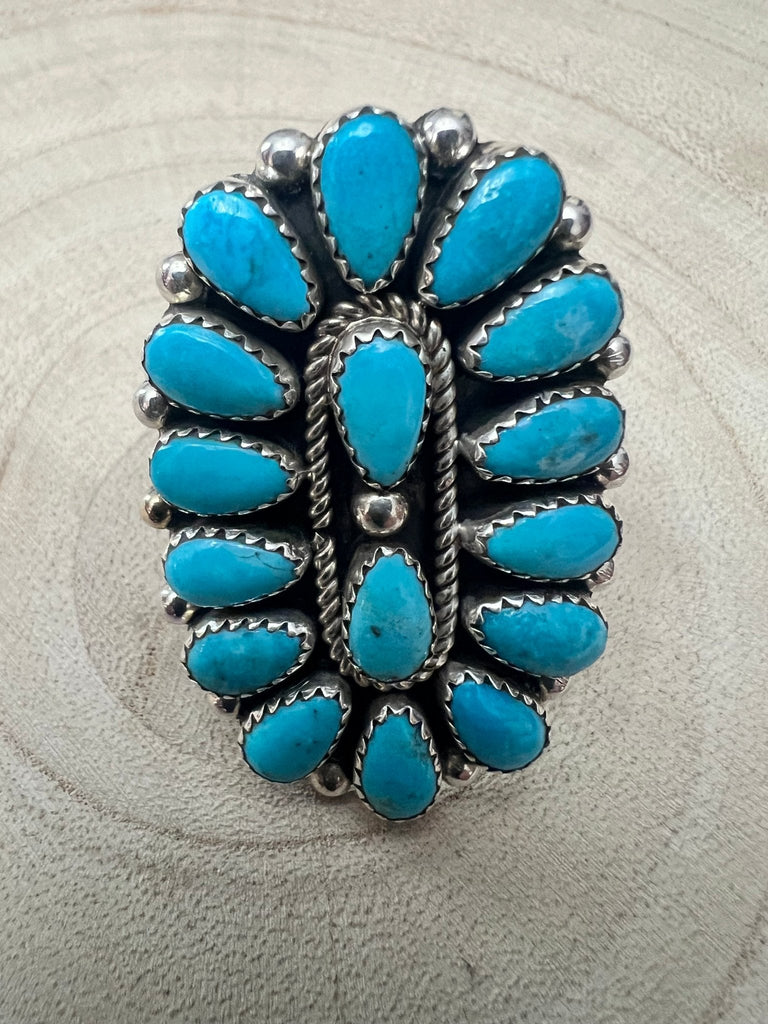
- Philena Byjoe Navajo Sterling Silver Cluster Ring with Turquoise ($999): A one-of-a-kind statement ring, 2 1/4″ × 1 3/4″, size 8, hallmarked PB and Sterling.
- Victor Coriz Navajo Sandcast Sterling Silver Ring with Orange Spiny Oyster ($229): Sandcast sterling with a thunderbird design and an orange spiny oyster center. Size 8.5.
- Sharon McCarthy Navajo Hand-Stamped Kingman Turquoise Drop Earrings ($67): Sterling silver with Kingman turquoise, a 1/2″ drop and the maker’s hallmark.

See more in our Authentic Native Jewelry collection.
Key facts: Navajo jewelry
- Navajo (Diné) silversmithing began in the mid-1800s. Atsidi Sani, also called Herrero, is credited as the first Navajo silversmith.
- Historians date the start between about 1850 and 1870, around the Bosque Redondo confinement of 1864 to 1868.
- Early Navajo silver was made from melted Mexican and US coins. Turquoise setting began in the 1880s.
- Signature techniques: hand stamping, repoussé, sand casting and tufa casting. Needlepoint is Zuni, and overlay is Hopi.
- Classic pieces: squash blossom necklaces with a naja, concho belts, cuffs, ketohs and bolo ties.
- Under the Indian Arts and Crafts Act of 1990, only Navajo Nation members or certified Navajo artisans can sell work as “Navajo.”
- “Sterling” or “.925” describes the metal, not the maker.
Curious what the squash blossom actually means? Our guide to squash blossom necklace meaning explains the naja, the “bead that spreads out,” where the name came from and what the design means to Diné wearers.
Frequently asked questions
What is the difference between Navajo and Zuni jewelry?
Navajo jewelry usually puts heavy silverwork first: hand stamping, cast silver and one or a few large stones. Zuni jewelry is known for lapidary skill, with many small, precisely cut stones in needlepoint, petit point, cluster and inlay designs. The two overlap. Navajo smiths began making Zuni-style cluster work in the 1940s.
Is all authentic Navajo jewelry signed?
No. Much older Navajo silver is unsigned, and hallmarks only became standard practice around the 1940s. Many Navajo artists sign their work today, but marks can be forged and some pieces carry only a trading-post mark. Treat a hallmark as one clue, and get the maker’s name and tribe in writing.
What does “Navajo style” mean on a jewelry listing?
It usually means the piece borrows Navajo design but was not made by a Navajo artist. The Indian Arts and Crafts Act makes it illegal to market a piece as Navajo unless a Navajo Nation member or certified Navajo artisan made it. The FTC adds that “descent” or “heritage” wording doesn’t mean the maker is a tribal member.
Who was the first Navajo silversmith?
Atsidi Sani, also known as Herrero, is credited as the first Navajo silversmith. He learned blacksmithing from a Mexican smith first. Historians disagree on when he began working silver. John Adair concluded Navajo silversmithing began somewhere between about 1850 and 1870, around the Bosque Redondo confinement of 1864 to 1868.
Is Navajo jewelry always made with turquoise?
No. Turquoise is the best-known stone, but Navajo artists also use coral, spiny oyster shell, opal, jasper and other materials, and many pieces are all silver. Stamped cuffs, sandcast bracelets and silver bead necklaces often have no stone. The silver and the maker define Navajo jewelry, not the stone.
Signed Navajo silver, named makers
Shop hallmarked Navajo and Native-made turquoise jewelry from our Fort Worth, TX shop, with the artist named on every listing. Orders ship in 24–48 hours, US shipping is free on orders over $50, and returns are accepted within 7 days in original condition. Use code WELCOME10 for 10% off your first order.
Found a stamp on the back of a piece? Our guide to Navajo hallmarks shows how to tell an artist’s mark from STERLING, .925, trading-post and old U.S. NAVAJO government stamps, why unsigned pieces can be genuine, and why a hallmark alone never proves who made it.