How to Clean Turquoise Jewelry Without Damaging It
Quick answer: Wipe turquoise with a soft, dry cloth after each wear. For grime, use a cloth barely dampened with lukewarm water and a drop of mild soap, wipe again with plain water, and dry right away. Never soak it or use ultrasonic or steam cleaners, ammonia, silver dips or chemicals. Polish only the silver, with a polishing cloth.
Turquoise is easy to wear and easy to ruin with the wrong cleaner: a silver dip, an ultrasonic tank or a long soak. Building on our Turquoise Buyer’s Guide, this guide covers the safe method step by step, care by stone type, tarnished silver, leather settings, and when to see a professional.

Why turquoise needs gentle cleaning
Turquoise is an aggregate of tiny crystals, which makes it relatively soft and porous. The International Gem Society rates it 5 to 6 on the Mohs scale, soft enough to be scratched by the quartz in household dust (7). GIA notes it can be discolored by chemicals, cosmetics, and even skin oils or perspiration, and that high heat can cause discoloration and surface damage.
How do you clean turquoise jewelry step by step?
You need two soft, lint-free cloths, lukewarm water, mild fragrance-free dish soap, a very soft toothbrush and a silver polishing cloth. Work over a towel or bowl, not an open drain, so you can’t lose a stone.
- Check the piece first: Look for loose stones, cracks or lifting inlay under good light. If anything moves or looks damaged, stop and take it to a jeweler instead of cleaning it.
- Wipe it dry: Wipe the stone and silver with a soft, dry, lint-free cloth to lift dust, skin oil and makeup.
- Use a barely damp cloth for grime: Add a drop of mild, fragrance-free dish soap to lukewarm water, dip a corner of a soft cloth, wring it out and wipe gently. Use a soft brush on the silver only. Never soak the piece.
- Wipe away the soap: Go over the piece with a second cloth dampened in plain water so no soap film is left on the stone.
- Dry it immediately: Pat dry, including the back and the edges of the bezel, then let it air-dry on a towel before storing.
- Polish the silver only: Use a silver polishing cloth on the metal to remove tarnish, keeping it off the stone and away from intentionally darkened areas.
- Store it separately: Keep each piece in its own soft pouch or lined slot, away from heat and harder gems.
GIA says it is “safe to clean turquoise jewelry with warm, soapy water.” A damp cloth does the same job with less water reaching the back of the stone.
What should you never use on turquoise?
- Ultrasonic cleaners: GIA lists turquoise among gems that shouldn’t go in an ultrasonic “regardless of whether they are treated or untreated.” The vibration can also shake stones loose.
- Steam cleaners: GIA says turquoise should never be steam-cleaned. Heat can discolor it and damage treated surfaces.
- Ammonia and household cleaners: GIA’s jewelry care tips warn that many household cleaners contain ammonia, which can be too harsh for delicate gems or vintage jewelry. That includes window cleaner.
- Silver dips and polishing creams: These are made for bare metal. On a stone-set piece they get onto and around the turquoise, which GIA notes can absorb metal polish.
- Bleach, acetone, alcohol and solvents: These can damage resin, dyes and the epoxy in composite stone and inlay.
- Vinegar, lemon juice, baking soda and toothpaste: Acids and abrasives. GIA notes turquoise slowly dissolves in hydrochloric acid, and abrasives dull the polish.
- Soaking: Even plain water can reach the stone’s pores and backing.
Does cleaning differ for natural, stabilized and dyed turquoise?
Yes. Treatment affects what a stone tolerates, which is why the FTC Jewelry Guides (16 CFR § 23.24) say treatments that create special care requirements should be disclosed. Our guides to stabilized vs natural turquoise and how to tell if turquoise is real explain the types. When in doubt, treat it as the most delicate type: dry cloth only.
| Stone or setting | Safe way to clean it | Avoid | Why |
|---|---|---|---|
| Natural (untreated) turquoise | Dry cloth. Barely damp, mildly soapy cloth only for grime. | Soaking, oils, lotions, perfume, any cleaner | Most porous. Absorbs oils and chemicals, which can change color. |
| Stabilized turquoise | Dry or damp cloth with mild soap | Heat, solvents (acetone, alcohol), steam, ultrasonic | The resin makes it tougher, but GIA warns heat or solvents can damage treated surfaces. |
| Dyed turquoise | Dry cloth only | Water on the stone, solvents, any cleaner | Added color can lift or fade. |
| Reconstituted, block or composite | Dry or barely damp cloth | Soaking, solvents, heat | Bonded with epoxy, which solvents and heat can weaken. |
| Inlay (turquoise with other stones) | Dry cloth, then a barely damp one | Soaking, ultrasonic, picking at the joints | Pieces are glued into channels, so water and vibration can loosen them. |
| Imitation Turquoise (dyed howlite, plastic, glass) | Dry cloth | Water on dyed howlite, solvents | Dye can rub off. Not turquoise at all. |
| Set in sterling silver | Polishing cloth on the metal | Silver dips, polishing cream, ammonia | Dips and creams can soak into or coat the stone. |
| Set on leather or suede | Dry cloth on the stone. Suede brush or dry cloth on the leather. | Soaking, leather conditioner near the stone | Leather can stain or stiffen when wet, and oily conditioners can be absorbed by the stone. |
Stabilized turquoise is the most forgiving, but heat and solvents still apply. Mine origin doesn’t change care: Kingman and Sleeping Beauty turquoise follow the same rules once you know whether the stone is natural or stabilized.
How do you clean tarnished sterling silver around turquoise?
Tarnish forms when silver reacts with sulfur compounds in the air. Clean the metal without letting cleaner reach the stone:
- Use a polishing cloth, not a liquid. Rub the silver with a jeweler’s polishing cloth, working up to the bezel but not across the stone. Retailer Garland’s recommends cloths for stone-set Native jewelry and warns never to use liquid or cream polish on pieces with turquoise.
- Leave intentional oxidation alone. Many Western and Native pieces are deliberately darkened in the recesses to make stamp work and twisted wire stand out. Polish only the raised surfaces, lightly.
- Respect vintage patina. On older signed pieces, worn gray silver is part of the character. Don’t make it look new.
- Go easy on plated metal. Silver-plated jewelry has a thin surface layer that heavy polishing can wear through. Use a plain soft cloth and light pressure.
Garland’s also notes that many Native silversmiths set stones on a bed of sawdust inside the bezel, a traditional cushion that can swell if it gets wet and push the stone out. It’s another reason to keep water away from set stones.


How do you clean turquoise set in leather?
Leather and turquoise both dislike soaking, so keep it dry.
- Wipe the stone dry. If needed, use a barely damp cloth on the stone only.
- For smooth leather, wipe with a dry or very slightly damp cloth. For suede, use a soft suede brush to lift dirt and restore the nap.
- If leather gets wet, blot it and air-dry it away from heat.
- Skip oily leather conditioner anywhere near the stone. Turquoise is porous and can absorb it.

How do hairspray, lotion and sweat affect turquoise?
GIA’s jewelry care tips note that everyday substances like hairspray, lotion, perfume and other cosmetics can permanently damage the surface of porous gems like turquoise. Its buyer’s guide adds that skin oil can gradually darken rings and beads that touch the skin. Follow the “last on, first off” rule:
- Put turquoise on after lotion, sunscreen, perfume and hairspray have dried.
- Take it off before showering, swimming, hot tubs, cleaning, gardening and workouts.
- After a hot day, wipe the stone and the inside of rings and cuffs dry.
Some darkening of natural turquoise is normal, usually can’t be cleaned away, and is prized by many collectors.
How should you store turquoise jewelry?
- Separately: Store each piece in its own soft pouch or lined compartment so harder gems and metal can’t scratch the stone.
- Against tarnish: GIA recommends keeping sterling silver in an anti-tarnish bag or cloth.
- Cool and dry: Avoid hot cars and steamy bathrooms. Heat can discolor turquoise.
- Leather that can breathe: Store leather and suede in a cloth pouch, not an airtight bag.
- Cuffs at their fitted size: Repeatedly opening and closing a cuff stresses the silver and the bezel.
When should you take turquoise jewelry to a professional?
GIA suggests having jewelry checked about every six months. See a qualified jeweler or silversmith if:
- A stone rattles, rocks or sits crooked in its bezel.
- You see a crack, chip or lifting inlay.
- Tarnish is deep in crevices a cloth can’t reach.
- A cuff needs resizing, or a ring shank has worn thin.
- A stone has suddenly changed color or gone chalky.
Tell the jeweler the piece has turquoise so it stays out of the ultrasonic and steam cleaner. On signed Native work, ask about experience with traditional settings. Keep your receipt: the Indian Arts and Crafts Board recommends it state whether the turquoise is natural, stabilized or treated, which tells a repairer how to handle it. (The Indian Arts and Crafts Act covers who made a piece, not how its stone was treated.)
How do we care for the turquoise pieces in our Fort Worth shop?
Real pieces available now from our Fort Worth, Texas shop, with details from each listing:
- Dorothy Series Sonoran Turquoise Patterned Silver Cuffs ($210–$230): Heavy-gauge sterling silver cuffs by Bootleg Silver Co., set with natural Sonoran turquoise in green, blue-green and blue tones, with floral, scroll and textured patterned wire. Sizes run from petite or child-size to medium-large. The listing says they may be adjusted one time only, so set the fit once and slip the cuff on and off your wrist from the side.
- Heritage Series Royston Turquoise Bolo Tie & Shadowbox Ring (ring $375, bolo $1,500, set $1,750): Natural Royston turquoise sourced from the Otteson family’s Royston Mine in Nevada, in fine and sterling silver with an oxidized finish. The bolo’s roughly 3″ × 3″ slider hangs on a hand-braided black leather cord of about 24″. The shadowbox ring is a size 9. Keep the cord dry and polish only raised silver.
- Annie Chapo Signed Vintage Navajo Sterling Turquoise Ring ($149): Signed “Chapo” on the band, with a turquoise cabochon showing gold-tone pyrite matrix. Size 7. Dry wipe, light cloth polish, never a dip.
- James Kee Navajo Turquoise & Opalite Inlay Cross Pendant ($129): Sterling silver, signed JK, about 2″ × 1½″. Inlay: dry cloth only.
- Suede Leather Belt with Leather Fringe and Turquoise Slab ($32): A 1½″-wide leather belt in 34″ or 40″, with antique gold rings, long fringe and a turquoise slab accent. Brush the suede and wipe the slab dry.
- Kingman Turquoise Large Single Stone Cuff ($64): An oval Kingman turquoise with natural matrix in a rope-and-bead bezel on a silver-plated, open split-shank cuff. Because it’s plated, use a soft plain cloth.
These listings don’t state whether each stone is stabilized, so use the gentlest routine for all of them. Browse more in our sterling silver bracelets or our Authentic Native Jewelry collection.
Buyer’s tip from Leather Stone Jewels
The care advice we give every turquoise buyer at our Fort Worth shop: a dry cloth first, a barely damp one only if needed, a polishing cloth on the silver, and never a tank or a dip. Keep a polishing cloth in your jewelry pouch and wipe each piece when you take it off. Not sure if a stone is natural or stabilized? Ask the seller before you clean it, and ask us about any piece before you buy.
Key facts: how to clean turquoise jewelry
- Turquoise is 5 to 6 on the Mohs scale and porous, so it scratches and absorbs oils and chemicals easily.
- GIA says warm, soapy water is safe for turquoise, but it should never be cleaned with steam or ultrasonic cleaners.
- Heat or solvents can damage treated (stabilized) turquoise surfaces.
- Never soak turquoise or use ammonia, bleach, silver dips, polishing cream, vinegar, baking soda or toothpaste on it.
- Clean tarnished silver with a polishing cloth on the metal only, and leave intentional oxidation alone.
- Put turquoise on after lotion, perfume and hairspray, and take it off before water or exercise.
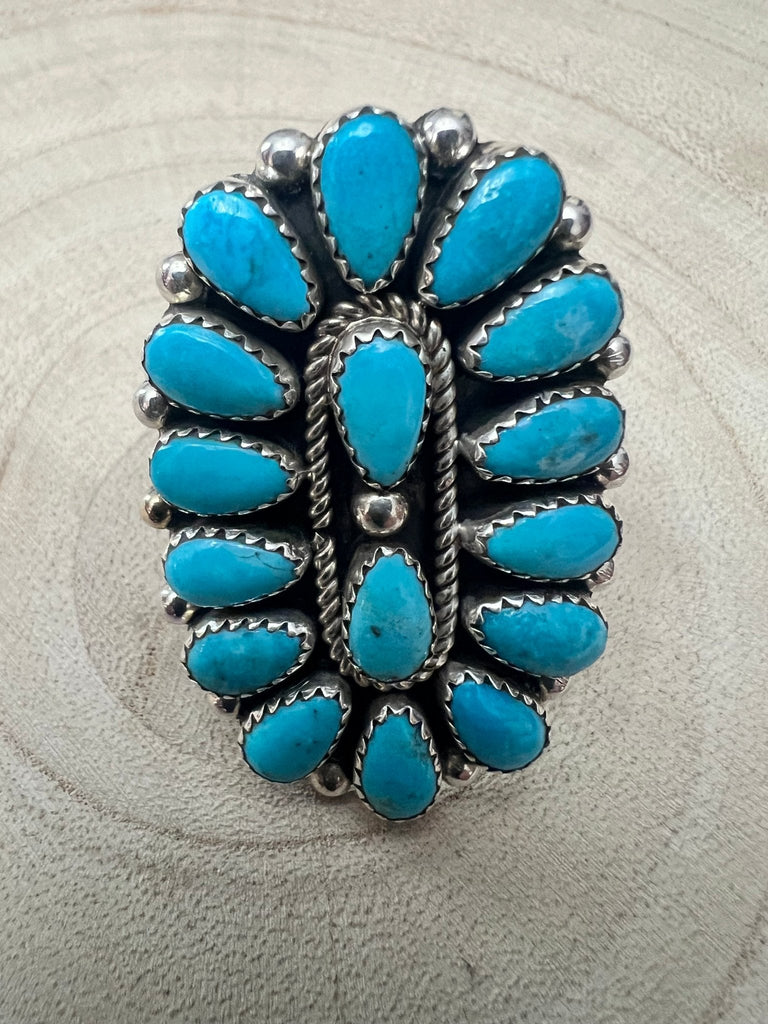
The same gentle routine works for stamped pieces like this hand-stamped sterling silver turquoise ring: a soft, dry cloth keeps the stamped silver bright without touching the stone.
Frequently asked questions
Can turquoise get wet?
A quick splash won’t ruin most turquoise, but it shouldn’t be soaked. Natural turquoise is porous, and many stones sit on a backing, adhesive or traditional sawdust cushion that can swell when wet. Take turquoise off before showering, swimming or washing dishes, and dry it right away if it gets wet.
Can I use a silver polishing cloth on turquoise jewelry?
Yes, on the silver. A treated polishing cloth is the safest way to remove tarnish from sterling around a stone. Work on the metal and keep the cloth’s polishing compound off the turquoise itself. Never use liquid silver dip or polishing cream on a stone-set piece.
Can you clean turquoise with vinegar, baking soda or toothpaste?
No. Vinegar is an acid, and GIA notes turquoise slowly dissolves in hydrochloric acid, so acids are a poor idea on a porous stone. Baking soda and toothpaste are abrasives that can dull turquoise’s polish. Stick to a soft cloth with a little mild soap and water.
Why is my turquoise turning green or darker?
Most turquoise is porous and absorbs skin oils, sweat, lotion and perfume over time, which can deepen or green its color. GIA notes rings and beads that touch the skin can gradually darken. Cleaning usually can’t reverse it, and many collectors value the change. Stabilized stone changes less.
Can I put turquoise in an ultrasonic or steam cleaner?
No. GIA says turquoise should never be cleaned with steam or ultrasonic cleaners, whether it is treated or untreated. Heat and vibration can damage the stone or any resin treatment and can shake stones loose in their settings. That applies to jeweler’s machines too, so tell any jeweler the piece has turquoise.
Turquoise made to be worn
Shop signed Navajo, handmade sterling and leather turquoise jewelry from our Fort Worth, TX shop, and ask us how to care for any piece. Orders ship in 24–48 hours, US shipping is free on orders over $50, and returns are accepted within 7 days in original condition. Use code WELCOME10 for 10% off your first order.